
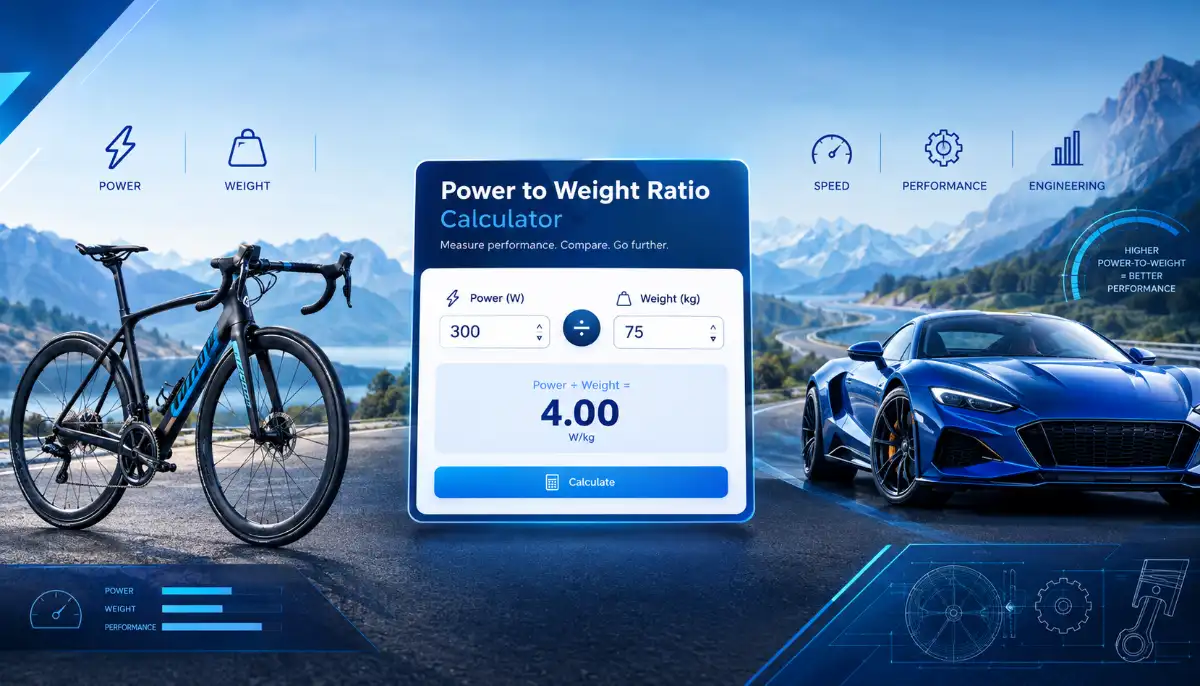
What Is a Power to Weight Ratio?
A Power to Weight Ratio Calculator helps you compare the amount of power available with the amount of mass that power needs to move. Looking only at horsepower or watts can sometimes give an incomplete picture because two machines can produce very different performance when their weights are not the same. A lighter vehicle with less power may have a stronger ratio than a heavier vehicle with a larger engine, while a cyclist producing fewer total watts may have a higher W/kg figure than a heavier rider producing more watts.
The basic idea is simple: power is divided by mass after the units have been converted into a consistent system. Our Power to Weight Ratio Calculator accepts watts, kilowatts or horsepower and lets you enter kilograms, pounds or metric tonnes. It then provides the result in useful formats such as W/kg, hp/lb and hp/tonne, so you do not have to perform separate unit conversions by hand.
This makes the calculator useful for cycling, cars, motorcycles, performance builds, engineering comparisons and general power-to-mass calculations. The number is especially helpful when you want a normalized comparison rather than simply comparing the largest horsepower figure.
Power to Weight Ratio Formula
The formula behind a Power to Weight Ratio Calculator is straightforward. First, power and mass need to be expressed in compatible units. For the standard metric calculation, power is converted to watts and mass is converted to kilograms. The watt is the SI unit of power, while kilograms are the standard SI unit used for mass. OpenStax explains power as the rate of doing work and identifies the watt as a joule per second. 1
W/kg = Power in Watts ÷ Mass in Kilograms
For example, if a cyclist produces 280 watts and has a mass of 70 kg, the calculation is 280 ÷ 70, which gives 4.00 W/kg. The same principle works for vehicles. If a car produces 300 horsepower and weighs 1,500 kg, its metric power-to-weight figure is 200 hp per tonne because 1,500 kg equals 1.5 metric tonnes.
The important point is consistency. You should not divide horsepower by kilograms and call the result W/kg. The calculator first converts the selected power and weight units and then performs the calculation. This avoids one of the most common mistakes when calculating power-to-weight manually.
How to Use the Power to Weight Ratio Calculator
Using this Power to Weight Ratio Calculator requires only two main values: power and weight. Choose the mode that best matches your situation, enter the available figures, select the correct units and press the Calculate Ratio button. The results remain hidden until valid values have been entered, which keeps the calculation area clean and prevents incomplete results from being displayed.
- Select a calculation mode. Choose Cycling, Vehicle or General depending on what you are comparing.
- Enter the power value. You can use watts, kilowatts or horsepower.
- Enter the weight or mass. The available options are kilograms, pounds and metric tonnes.
- Check the selected units. Make sure the unit selector matches the number you entered.
- Click Calculate Ratio. The calculator will show W/kg, hp/lb and hp/tonne results.
If either field is empty, zero or invalid, the calculator displays a validation message instead of producing a misleading result. If you change between Cycling, Vehicle and General modes, the previous result is cleared so that the new calculation starts with a clean input area.
Understanding Your Power to Weight Ratio Result
A higher power-to-weight number means that more power is available for each unit of mass. This is generally advantageous when the goal is to accelerate a vehicle, climb a hill or move a system efficiently under conditions where mass has a significant effect. However, the result should be interpreted in context rather than treated as a complete prediction of real-world performance.
The main result from the calculator is expressed as W/kg. This is particularly familiar in cycling and sports performance. The calculator also gives hp/lb and hp/tonne, which can be more convenient when working with vehicle specifications. These are simply different ways of describing the same underlying relationship between power and mass.
| Unit | Meaning | Common Application |
|---|---|---|
| W/kg | Watts of power per kilogram | Cycling and general metric comparisons |
| hp/lb | Horsepower per pound | Vehicle performance comparisons |
| hp/tonne | Horsepower per metric tonne | Cars and motorcycles |
Power to Weight Ratio for Cycling
Cycling is one of the most common applications for a power-to-weight calculation. Riders often use W/kg to compare their power output relative to body mass, particularly when evaluating climbing performance. When riding uphill, gravity works against the combined mass of the rider and bicycle, so producing more power for a given mass can provide an important advantage.
A rider producing 250 watts at 70 kg has a ratio of approximately 3.57 W/kg. If the same rider produces 280 watts at the same mass, the figure rises to 4.00 W/kg. The improvement can also come from a lower mass if power is maintained, but weight reduction should always be considered alongside health, recovery and the ability to maintain power.
It is also important to consider the duration of the effort. A short sprint power value should not be compared directly with a long-duration threshold or endurance value. Cycling performance depends on power duration, terrain, aerodynamics, pacing, bike setup and riding conditions. Power-to-weight is therefore a useful metric, but it is not the only factor that determines how fast a cyclist will ride.
If you want to understand the broader concept of power in physics, the OpenStax explanation of power provides a useful educational reference. It explains the relationship between work, time and power and gives the watt and horsepower conversions used in common calculations. 2
Power to Weight Ratio for Cars and Motorcycles
For cars and motorcycles, power-to-weight is useful because horsepower alone does not account for the mass of the vehicle. Imagine two cars with different engine outputs. If the more powerful car is substantially heavier, its advantage may be smaller than the raw horsepower figures suggest. Expressing performance as horsepower per tonne puts the two vehicles on a more comparable basis.
For example, a 300 hp car weighing 1,500 kg has a power-to-weight figure of 200 hp/tonne. A 400 hp car weighing 2,000 kg also produces 200 hp/tonne. Although the second car has 100 more horsepower, both vehicles have the same horsepower relative to their mass.
That does not mean both cars will necessarily have identical acceleration. Transmission gearing, tire grip, drivetrain efficiency, torque delivery, launch conditions and aerodynamic drag can all change the real-world result. A power-to-weight calculation is best used as a clear comparison metric rather than a complete vehicle-performance simulation.
For vehicle specifications, it is also important to use comparable weight figures. A manufacturer's curb weight, a dry weight and a fully loaded track weight are not necessarily the same. If you are comparing two vehicles, use the same type of weight measurement for both whenever possible.
Power and Weight Unit Conversions
One reason people use a calculator instead of doing the calculation manually is that power and mass are frequently listed in different units. A vehicle specification may provide horsepower and pounds, while another source may use kilowatts and kilograms. The conversion needs to happen before the ratio is calculated.
Horsepower to Watts
The calculator uses mechanical horsepower for the hp input. NIST lists horsepower of 550 foot-pound-force per second as approximately 745.7 watts and also provides conversion factors for pounds, tonnes and other units. 3
For practical calculations, the relationship can be written as approximately 1 hp = 745.7 W. Kilowatts use the simpler relationship 1 kW = 1,000 W.
Pounds and Tonnes to Kilograms
One avoirdupois pound is approximately 0.45359237 kg, while one metric tonne equals 1,000 kg. NIST provides these conversion factors in its SI conversion tables. 4
Because the calculator performs these conversions internally, you can enter the values in the units supplied by your specification sheet without first converting everything manually.
Power to Weight Ratio Examples
These examples show how the same basic calculation works across different situations. They are intended to demonstrate the mathematics rather than define universal performance categories.
| Power | Mass | Result |
|---|---|---|
| 200 W | 80 kg | 2.50 W/kg |
| 250 W | 70 kg | 3.57 W/kg |
| 280 W | 70 kg | 4.00 W/kg |
| 300 hp | 1,500 kg | 200 hp/tonne |
| 400 hp | 1,600 kg | 250 hp/tonne |
These examples demonstrate an important principle: if power increases while mass stays constant, the ratio increases. If mass decreases while power stays constant, the ratio also increases. This is why the metric is useful when comparing different vehicle configurations or tracking changes in cycling performance over time.
How to Improve Your Power to Weight Ratio
There are two mathematical ways to increase a power-to-weight result: increase power while keeping mass constant, or reduce mass while maintaining the same power. In some cases, both can happen together. The best approach depends heavily on whether the calculation is being used for cycling, motorsport, engineering or another application.
For Cyclists
- Develop sustainable power through appropriate training.
- Track power using consistent testing conditions.
- Monitor body mass without sacrificing health or recovery.
- Compare similar power-duration measurements.
- Consider the rider, bicycle and equipment when defining total system mass.
For Vehicles
- Compare vehicles using consistent weight measurements.
- Consider useful weight reduction where appropriate and safe.
- Compare crank or engine power with comparable figures rather than mixing measurement methods.
- Consider traction, gearing and drivetrain losses in addition to the ratio.
- Remember that aerodynamic drag becomes increasingly important at higher speeds.
How Accurate Is a Power to Weight Ratio Calculator?
The arithmetic behind a Power to Weight Ratio Calculator is exact when the input values and conversion units are correct. The calculator converts the entered power to watts, converts the entered mass to kilograms and divides the two values. The accuracy of the final number therefore depends primarily on the accuracy of the power and mass figures supplied by the user.
Real-world performance is more complicated. A vehicle's power-to-weight figure does not directly include aerodynamic drag, rolling resistance, tire grip, transmission gearing or drivetrain efficiency. In cycling, terrain, wind, pacing, bike position and the duration of the effort also matter. This is why the ratio should be viewed as a useful comparison rather than a guarantee of a particular speed or acceleration time.
Related Calculation Tools
If you use online calculators regularly, you may also find some of our other measurement and calculation tools useful. For example, our Cubic Yard Calculator can help with volume-related calculations, while the PFT Calculator is designed for a different type of performance calculation. These tools use the same simple goal: turn a calculation that could require several manual steps into a quick, easy-to-check result.
If you need a second measurement-related tool, the PFT Calculator / CFT Calculator can also be useful when working with measurement conversions and related calculations. We recommend using the tool that matches the exact type of calculation you are trying to perform rather than combining unrelated metrics.
Power to Weight Ratio Calculator FAQs
What is a Power to Weight Ratio Calculator?
A Power to Weight Ratio Calculator determines how much power is available for a given amount of mass. It can be used for cyclists, cars, motorcycles and general performance comparisons. The calculation is based on dividing power by mass after converting the values into compatible units.
How do you calculate power to weight ratio?
Divide power by mass. For the metric W/kg calculation, convert power to watts and mass to kilograms, then divide watts by kilograms. For example, 300 watts divided by 75 kg equals 4.00 W/kg.
What does W/kg mean?
W/kg means watts per kilogram. It describes how much power is available for each kilogram of mass and is commonly used in cycling and other performance comparisons.
What is a good power to weight ratio?
There is no single number that is good for every application. Cycling ratios depend on the duration of the effort and the rider's fitness, while vehicle ratios depend on vehicle type and intended use. The most useful approach is to compare similar measurements under similar conditions.
Is a higher power to weight ratio better?
Generally, more power per unit of mass is advantageous for acceleration and climbing. However, the ratio does not include every factor affecting performance. Traction, aerodynamics, gearing, drivetrain efficiency, terrain and power delivery can all influence the final result.
How is cycling power to weight calculated?
Cycling power to weight is commonly calculated by dividing power in watts by mass in kilograms. For example, a rider producing 280 W at 70 kg has a ratio of 4.00 W/kg. The duration of the power effort should also be considered.
How is vehicle power to weight calculated?
A common vehicle measurement is horsepower per metric tonne. Divide horsepower by the vehicle's mass in tonnes. For example, 300 hp divided by 1.5 tonnes equals 200 hp/tonne.
Can I calculate power to weight using pounds?
Yes. Enter the mass in pounds and select lb. The calculator converts the value to kilograms for the W/kg calculation and also provides the horsepower-per-pound result.
Should I use curb weight or loaded vehicle weight?
Use the weight that matches the comparison you are making. For manufacturer specification comparisons, a consistent curb-weight figure is useful. For a real driving or track estimate, including the driver, fuel, passengers and equipment can provide a more realistic system mass.
Does power to weight predict acceleration?
It can provide a useful indication of acceleration potential, but it cannot predict an exact acceleration time. Tire grip, gearing, torque delivery, drivetrain losses, aerodynamics and launch conditions can all affect actual acceleration.
Calculate Your Power to Weight Ratio
Whether you are checking cycling performance, comparing cars or motorcycles, evaluating a performance build, or simply learning how power and mass interact, the Power to Weight Ratio Calculator gives you a quick way to make the calculation. Enter your power and mass, choose the units you already have, and the calculator handles the conversions automatically.
For the most meaningful comparison, keep the measurement method consistent. Compare similar types of power measurements and similar definitions of mass, and remember that the ratio is only one part of real-world performance. When used with the right context, a power-to-weight calculation provides a clear and useful way to understand how much output is available relative to the mass being moved.