
AP Chemistry Score Calculator: Accurate & Easy Score Guide
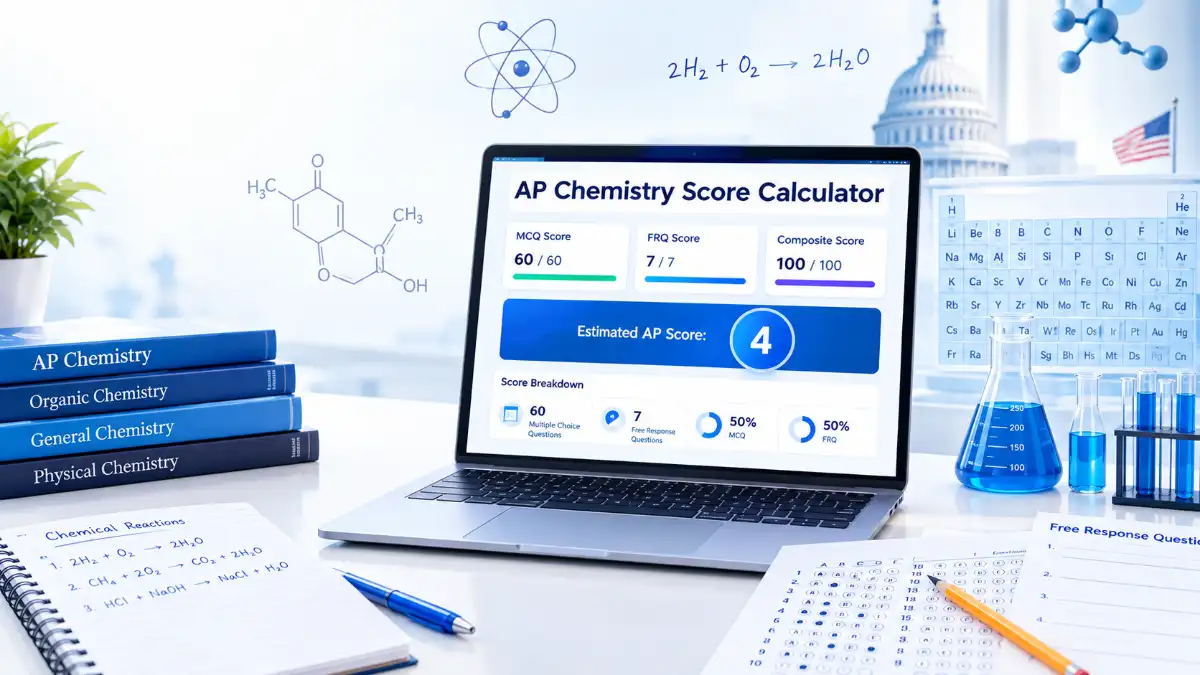
Preparing for the AP Chemistry exam makes it difficult to tell how you’re progressing when practice tests report multiple-choice and free-response results separately. This calculator combines both sections to estimate your overall AP score on the 1–5 scale. Enter your multiple-choice result along with the points earned on each free-response question, then click the button to see your estimated composite and projected AP scores. This AP Chemistry Score Calculator is designed for students who want a simple way to check their progress before the AP Chemistry exam.
How the AP Chemistry Score Calculator Works
The AP Chemistry Score Calculator follows the exam’s current format. Multiple choice makes up Section I, with 60 questions worth 50% of the final score. Section II accounts for the other half and contains seven free-response questions: three long questions worth 10 points each and four short questions worth 4 points each. Together, they total 46 raw points. The calculator converts both sections into weighted scores, combines them, and produces an estimated composite score out of 100, giving you a quick way to judge your performance on practice tests.
What You Need to Enter
To use the AP Chemistry Score Calculator, Enter your correct answers from the 60 multiple-choice questions first. Then add the raw score for each of the seven free-response questions: each long FRQ is worth up to 10 points, while each short FRQ can earn as many as 4. Leave anything blank, and the calculator will ask you to complete the missing fields before showing an estimate. With every score entered, it can produce a more accurate practice estimate.
AP Chemistry Exam Scoring Breakdown
Your AP Chemistry result comes from two sections, each worth half of the final score. The multiple-choice portion has 60 questions, while the free-response portion has seven; together, they account for the other 50%. Because the sections award different numbers of raw points, the AP Chemistry Score Calculator converts each one to a 50-point scale before adding them. That makes it easier to see how each section affects your estimated overall score.
| AP Chemistry Section | Questions | Raw Points | Exam Weight |
|---|---|---|---|
| Multiple Choice | 60 | 60 | 50% |
| Free Response | 7 | 46 | 50% |
| Long FRQs | 3 | 30 | Part of FRQ section |
| Short FRQs | 4 | 16 | Part of FRQ section |
How Your AP Chem Composite Score Is Estimated
The AP Chemistry Score Calculator first converts your multiple-choice performance into a score worth up to 50 points. It does the same with your combined free-response performance, assigning another possible 50 points. Those two results produce a composite score from 0 to 100, which the calculator matches to an estimated band and a projected AP score of 1 to 5. It can help you practice and monitor your progress, but the result is only an estimate—not an official College Board score.
Multiple-Choice Calculation
The multiple-choice section has 60 questions, and your score is based on how many you get right. Answering 42 correctly gives you a raw score of 70%. Because the section makes up half of the exam, that result contributes about 35 points to the 100-point composite calculated by the AP Chemistry Score Calculator.
Free-Response Calculation
The seven free-response scores add up to a raw score out of 46. That number is converted to a weighted score worth up to 50 points. Entering each FRQ separately also shows how your results on the long and short questions affect the estimate from the AP Chemistry Score Calculatorr.
What Is a Good AP Chemistry Score?
A 3 on the AP scale generally means qualified; a 4 indicates strong preparation, and a 5 reflects exceptional preparation. Colleges set their own standards, though, so one school may award credit for a 3 while another may require a 4 or 5. If college credit is your goal, check the latest AP credit and placement policies at every school you’re considering. Before you do that, the AP Chemistry Score Calculator can give you a clearer sense of how your practice scores are shaping up.
What Score Do You Need for a 5 on AP Chemistry?
A particular raw score does not guarantee a 5 on the AP Chemistry exam every year. The scoring process is reviewed annually, so the raw-score range associated with final scores from 1 to 5 may change. Use an AP Chemistry Score Calculator to guide your preparation, not to predict your exact exam result. Track whether your practice performance improves and use the results to identify the sections that need more work.
How to Improve Your AP Chemistry Score
To raise your AP Chemistry score, combine content review with timed practice. The exam tests more than formula recall: you may need to read data, interpret models, calculate results, explain your chemical reasoning, or support a scientific claim. When you finish a practice test, go back through every missed question and figure out what caused the error instead of simply looking at the answer key. After the next session, use the AP Chemistry Score Calculator again to see how your score has changed.
Practice Multiple-Choice Questions
For AP Chemistry multiple-choice practice, do more than identify the right answer. Explain why it works and why each alternative fails. Give special attention to chemical representations, experimental design, graphs, calculations, equilibrium, thermodynamics, kinetics, acids and bases, and molecular interactions. Timed sets help, too; they train you to handle unfamiliar questions without getting stuck on one for too long. Once you finish, enter your correct answers into the AP Chemistry Score Calculator so you can track your progress.
Practice AP Chemistry FRQs
Free-response practice matters because AP Chemistry FRQs test both scientific reasoning and clear communication. Show your work, explain why you reached each conclusion, include the right units, and answer the question being asked—not a nearby one. Released scoring guidelines clarify how points are assigned and reveal the mistakes that commonly cost students credit. TheAP Chemistry Score Calculator also lets you enter each FRQ score separately, so you can see how your written answers affect your estimated score.
Track Your Progress Over Time
One practice score does not tell the whole story. Try the AP Chemistry Score Calculator after several practice sessions and record your results. If your composite score gradually increases, that is a stronger sign of progress than one unusually high or low practice test. You can also compare your MCQ and FRQ contributions separately to determine where additional study time is likely to help most.
AP Chemistry Topics You Should Be Ready For
AP Chemistry covers a lot of ground, so preparation should center on the major ideas: atomic structure, molecular and ionic compounds, intermolecular forces, reactions, kinetics, thermodynamics, equilibrium, acids and bases, and electrochemistry. You will also need the practical skills the exam tests—working through calculations, interpreting data, using models and representations, reasoning from evidence, and building clear scientific arguments. Strong command of these areas can improve the accuracy of an AP Chemistry Score Calculator.
Why Use This AP Chem Score Calculator?
A good score calculator should make practice results easier to understand, not bury students in unnecessary detail. With this AP Chemistry Score Calculator, enter your scores and click the calculation button to see your estimated AP score, composite score, and section-by-section breakdown. Before calculating, it checks that every required field is complete and that each score falls within the accepted range.
AP Chemistry Score Calculator vs. an Official AP Score
An AP Chemistry Score Calculator can give you a reasonable projection by using the published exam format and an estimated conversion scale. It cannot replace your official AP score, which only the College Board issues. Treat the result as an estimate: your final score may differ because each exam administration has its own conditions and the scoring process can change from year to year.
When Should You Use an AP Chemistry Score Calculator?
After a full-length practice test or a batch of released questions, use an AP Chemistry Score Calculator to estimate your score. It can also help during the last few weeks before the AP exam by showing how your results change over time and helping you set realistic targets. If your multiple-choice question (MCQ) scores regularly exceed your free-response question (FRQ) scores, spend more time writing explanations and showing calculations instead of doing only more multiple-choice practice.
Official AP Chemistry Resources
Check the official College Board resources for the latest AP Chemistry exam details. They explain the format, section timing, number of questions, and scoring weights. You can also find the official course materials and released free-response questions for practice.
Frequently Asked Questions About the AP Chemistry Score Calculator
How many questions are on the AP Chemistry exam?
The AP Chemistry exam has 60 multiple-choice questions in Section I and seven free-response questions in Section II. The free-response section contains three long questions and four short questions.
How much is the AP Chemistry multiple-choice section worth?
The multiple-choice section represents 50% of the AP Chemistry exam score. It contains 60 questions and lasts 1 hour and 30 minutes.
How much is the AP Chemistry FRQ section worth?
The free-response section represents 50% of the AP Chemistry exam score. It contains seven questions worth 46 raw points in total: three long questions worth 10 points each and four short questions worth 4 points each.
Is the AP Chemistry Score Calculator official?
No. This calculator is an independent estimation tool for practice and preparation. It is not an official College Board score report, and your official AP score may be different from the calculator estimate.
Can I use this calculator with a practice AP Chemistry exam?
Yes. You can enter the number of multiple-choice questions you answered correctly and the points you earned on each FRQ from a practice exam to get an estimated composite and AP score.
What is the maximum AP Chemistry FRQ score?
The seven AP Chemistry free-response questions are worth 46 raw points in total. The three long questions are worth 10 points each, while the four short questions are worth 4 points each.
Can a calculator guarantee that I will get a 5?
No. A score calculator cannot guarantee an official AP score. It provides an estimate based on the scoring model used by the tool, while the College Board determines the official score through its own scoring and reporting process.
How can I improve my AP Chemistry score?
Review the concepts behind your missed questions, practice released multiple-choice and free-response questions, work on calculations and scientific explanations, and take timed practice exams. Tracking both your MCQ and FRQ performance can help you identify your weakest area.
Use Your Practice Score to Plan Your Next Study Session
Treat the calculator’s result as feedback, not a final verdict. Compare how you performed on multiple-choice and free-response questions, then revisit the chemistry concepts behind anything you missed. Take another timed practice test and repeat the review. Regular practice will help the AP Chemistry Score Calculator show whether your preparation is moving in the right direction before test day.