
Asphalt Calculator – Estimate Tons, Volume & Cost
If you are working on a driveway, parking lot, or paving project in U.S. you can use our Asphalt Calculator. to determine the amount of asphalt you will need. Enter in the length, width of your area and the pavement thickness which in turn will tell you the required tonnage and volume. Also you can estimate material costs, add extra asphalt for waste, and create your budget before you start.
Estimate Your Asphalt Needs
Fields marked * are required. All others are optional.
Your Result
Enter the length, width and thickness, then press Calculate Asphalt to see your estimate here.
Asphalt Calculator: Complete Guide
Explore asphalt calculation formulas, material density, driveway costs, recycled asphalt millings, and practical paving estimates. Select a topic below to read the details you need.
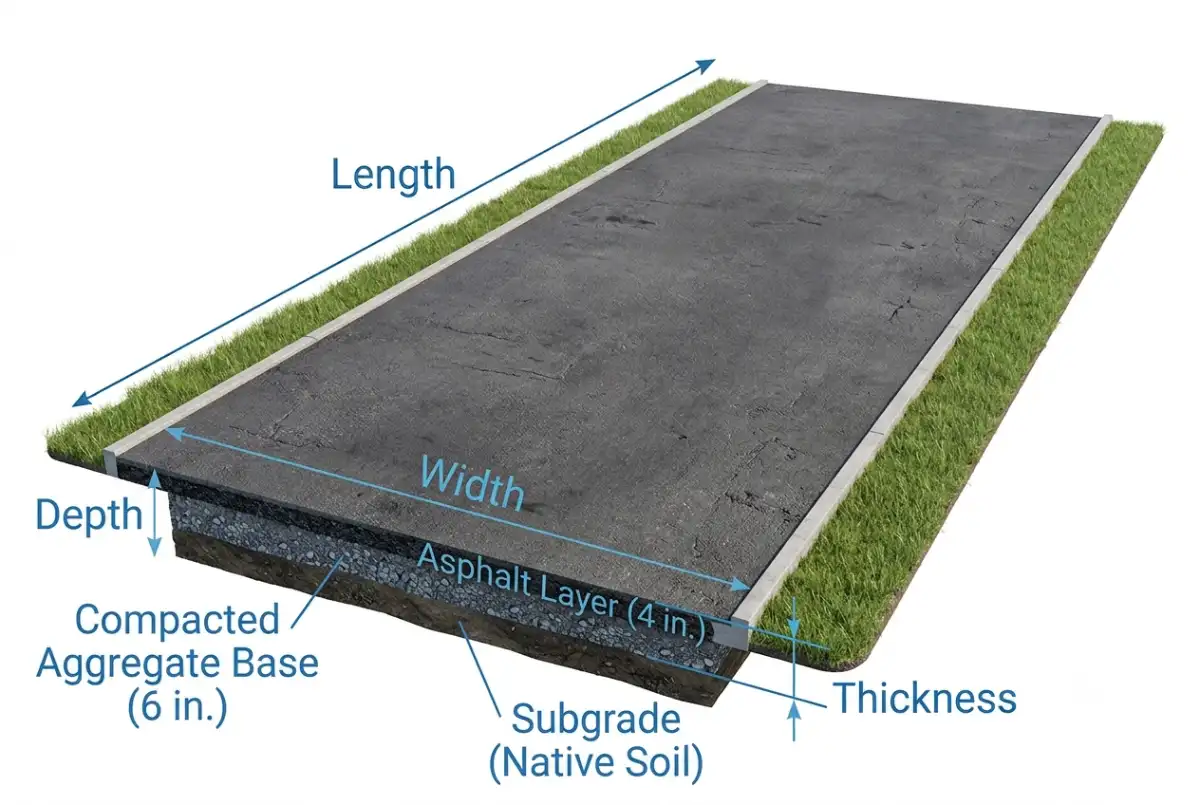
Using a very easy to use asphalt calculator just enter the dimension of the area to be paved in feet (length and width), also input the compacted layer thickness in inches. Also most do not forget to include a waste factor of 5 10% and a price per ton for cost estimates. Just hit “Calculate” and the tool will present you the total volume in cubic yards or feet and weight in tons of asphalt you will need. For example if you put in a 30’ by 20’ driveway at 4” deep you will see that it will take up about 200 ft^3 of material which is at large around 14.5 tons of hot mix asphalt. Today’s advanced asphalt tonnage calculators also do all the unit conversions for you. so you don’t have to manually switch between units or worry about density – you just read off the quantities and costs. This friendly interface turns complex math into a quick answer, helping both DIYers and pros plan projects accurately.
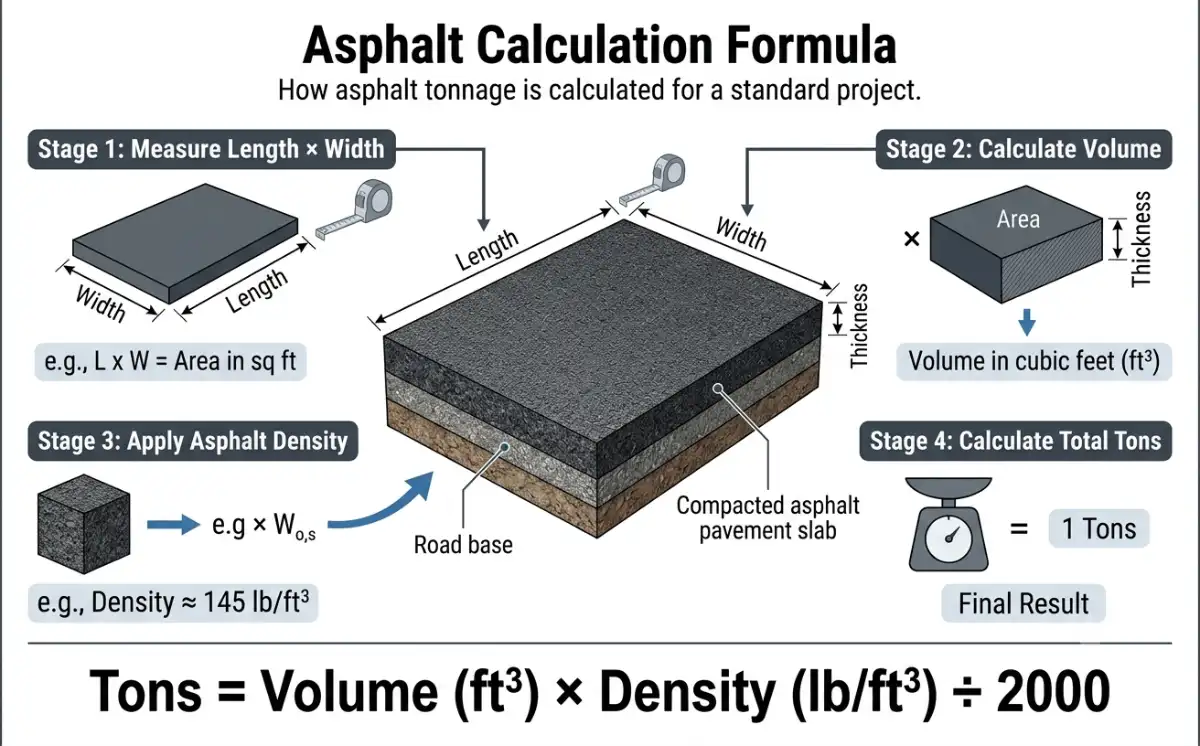
Under the hood, asphalt calculators use a straightforward formula: Tons = (Area × Depth × Density) / 2000. In practice, the tool first computes volume = Length × Width × (Depth ÷ 12) in cubic feet, then multiplies by the asphalt density (typically 145 lb/ft³ for hot mix) and divides by 2,000 lb/ton. Finally it applies any waste allowance. In simplified form, a handy rule is tons = area (ft²) × depth (in) × 0.00604. For example, a 1,000 sq ft parking pad at 3″ depth needs about 18.1 tons (since 1,000×3×0.00604 ≈ 18.12). The calculator may also offer metric options (tonnes, meters) by using a conversion factor: roughly 2.322 tonnes per square meter per inch of thickness. It handles all unit conversions, so you never have to divide by 27 (ft³ to yd³) or convert pounds to tons yourself. In short, the asphalt calculator ensures you get consistent units – whether you input yards or feet, inches or centimeters – and outputs the total tons (or tonnes) needed for the job.
An important factor in asphalt calculations is material density. Hot mix asphalt typically compacts to about 145 lb/ft³ (≈2322 kg/m³). Warm mix is almost the same (~144 lb/ft³), and cold patch asphalt slightly less (~137 lb/ft³). Loose asphalt (in the truck) is fluffier – roughly 117 lb/ft³ – about 20–25% lighter than compacted. That’s why you must use compacted thickness in your formula: using loose thickness would overestimate needed tons by about 25%. Most asphalt calculators default to the standard 145 lb/ft³, but some let you adjust density if you know your supplier’s mix. For recycled asphalt millings, the density is slightly higher when compacted (around 148 lb/ft³). The calculator combines area, thickness, and density to give the total mass, then converts that to tons (one US ton = 2000 lb). In essence, the calculator saves you from having to look up or remember these densities – it already builds them in so your result is the tons of asphalt to order.
Learn more about asphalt materials and pavement technology from the Asphalt Institute.
After calculating tons, a friendly asphalt driveway cost calculator can multiply that quantity by your local price per ton to give an instant budget. Asphalt material alone often costs $100–$200 per ton. Installation (labor, base prep, etc.) can bring the total to about $7–$13 per square foot of driveway. For example, a standard 600 sq ft residential driveway might run $4,200–$7,800 all-in. Note that costs vary by region and job complexity: urban areas or regions with short paving seasons (Northeast) tend to be pricier. Many calculators allow you to enter your cost-per-ton or per-square-foot so the output shows the total estimated project cost. This way, you can compare options – for instance, computing costs for different asphalt types or thicknesses – right in the tool. A “driveway cost estimator” also reminds you to consider extras like permit fees, sealcoating, or striping, which are often added line items in a quote.
An asphalt millings calculator works the same way but uses recycled asphalt (millings) instead of new hot mix. Millings are the crushed-up leftovers of old asphalt pavement, which still have some binder in them. Because they already contain bitumen, millings will bind together when compacted. They’re usually sold by the ton and are cheaper than new asphalt – often around $40–$80 per ton for base layers. Our calculator will use a density of about 148 lb/ft³ for compacted millings. You enter the same dimensions (area and depth) and it returns tons and cost. For example, a 50×12 ft road at 4″ deep needs about 16 tons of millings. The tool also highlights recommended depths: typically 3–4 inches of compacted millings for a home driveway and 4–6 inches for heavier use (parking or farm roads). Using an asphalt millings calculator helps you order the right amount of this recycled material, avoiding costly reorders or wasted leftovers.
Different projects call for different areas and thicknesses, and the calculator handles them all. For a small driveway (e.g. 500 sq ft) at a standard 3-inch depth, you’d need roughly 9–10 tons (plus 5–10% waste). A medium parking pad (e.g. 1,000 sq ft at 4″) requires around 24–27 tons. Heavy-duty jobs like a commercial lot might call for 4–6 inches of asphalt, pushing tons even higher. The rule of thumb is about 0.018 tons per sq ft-inch of depth. For example, the formula area×depth×0.00604 gave ~18.1 tons per 1,000 sq ft at 3″. You can mix and match: think of a sidewalk or patch needing 2 inches, vs. a driveway turning area or loading zone needing 6 inches. If there are curves or irregular shapes, break them into rectangles or use our measurement guides – but the asphalt calculator itself won’t mind the dimensions, it will do the math as long as you can sum the total area and set one depth. No matter the scenario – driveway, overlay, patch, or trail – the asphalt calculator quickly shows how many tons (and dollars) you should plan for.
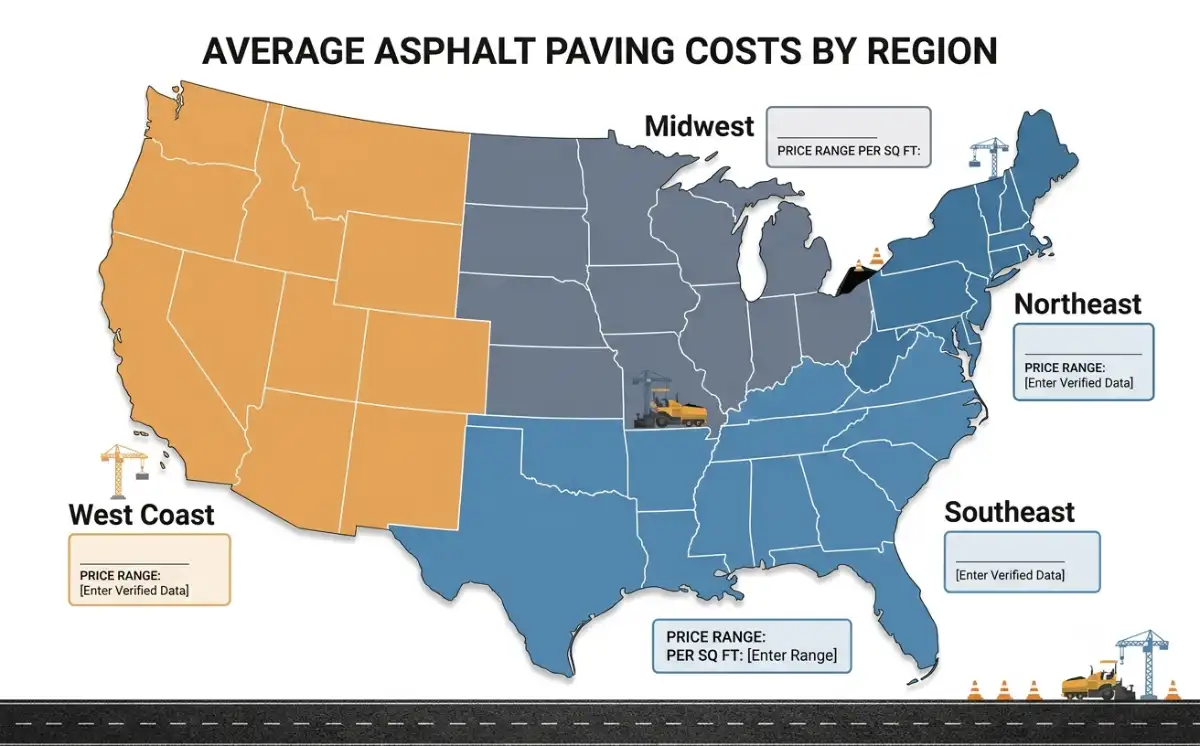
Asphalt prices vary widely across the U.S. due to labor rates, oil prices, and climate. In the Southeast (FL, GA, NC, etc.) where paving is year-round, prices are relatively low – about $80–$110 per ton of asphalt and ~$3–$6 per sq ft installed. The Midwest (IL, OH, MI, etc.) sees moderate costs around $90–$120 per ton ($4–$7 installed). The West Coast and Northeast are highest: expect $100–$150 per ton ($6–$10 per sq ft installed) in places like CA and NY. For instance, North Carolina might offer asphalt at $95–$135 per ton, while California could be $100–$140. These ranges are material costs – installed prices include labor and prep. A good calculator (or cost estimator) will let you choose your region or adjust the price-per-ton to see the impact. Always remember to get local quotes: the best way to refine the regional estimate is to enter your own local price per ton or sq ft in the calculator. Despite regional differences, using the same asphalt calculator and formulas guarantees you can compare “apples to apples” between quotes.
An asphalt calculator takes the guesswork out of ordering. Getting the quantity right saves you money and prevents delays. It automates all the unit conversions and math, ensuring you order the correct tons the first time. Since asphalt is sold by the ton, the calculator’s output (tons to order) matches exactly what the plant will deliver. This avoids the common mistake of ordering by surface area alone and ending up short (or with too much leftover). A calculator also highlights how waste (trim, overages) affects the total, so you can avoid mid-project shortages. In friendly terms, it’s like having an expert guide you through the calculation: no need to remember the density, conversion factors, or trick formulas. Whether you’re a homeowner budgeting a new driveway or a contractor writing bids, an asphalt tonnage or asphalt ton calculator ensures confidence and accuracy in your estimate. It even helps you make smarter decisions — for example, you can compare in seconds the tonnage (and cost) of different thicknesses, or of new hot mix versus recycled millings. All this means fewer surprises when the asphalt trucks show up.
Ready to get started? Grab your tape measure and give our easy asphalt calculator a try. Enter your project dimensions, choose the thickness and material type, and see instantly how many tons of asphalt (or millings) you’ll need and what it might cost. If you have questions or a larger project, contact a local paving supplier – they can provide up-to-date per-ton pricing for your area. With the right numbers in hand, you’ll pave smarter, avoid waste, and stay on budget. Use the asphalt calculator today and take the guesswork out of your paving project!
Frequently
Asked Questions
Measure the area (length×width) and thickness, convert to volume (L×W×depth/12 for cubic feet), then to cubic yards (÷27) and multiply by density. Equivalently, Tons = (L×W×depth_in_ft × 145) ÷ 2000.
Use Volume (ft³) = Length(ft) × Width(ft) × (Depth(in) ÷ 12). Then Cubic Yards = Volume ÷ 27. For tonnage: Tons = Cubic Yards × 2.025 (for HMA).
Standard compacted hot-mix asphalt is about 145 lb/ft³ (≈2.025 tons/yd³). For recycled millings, use ~140 lb/ft³ (1.89 tons/yd³). The tool default is 145, but you can adjust if known.
Multiply the calculated tons by your local price per ton, then add labor cost: typically $1–$3 per ft² for residential paving. Our cost estimator does: Cost = (Tons × $/ton) + (Area × $/ft² labor).
For light residential use, 2–3 inches of compacted asphalt over a base is typical. Use 3–4 inches if you expect heavier trucks or RVs. Too-thin lifts will fail early, too-thick is extra cost.
Not directly. You must include thickness. You can multiply area (ft²) × thickness (ft) to get cubic feet, then convert: Cubic Yards = (Area×depth) ÷ 27; Tons = Cubic Yards×2.025. For example: 50×10 ft at 3″ (0.25 ft) → 125 ft³ ÷27 ≈ 4.63 yd³ → ×2.025 ≈ 9.37 tons.
It ensures accurate material takeoffs so you order enough without waste. Accurate estimates save time and money. Professionals use such tools to avoid under-ordering (stopping mid-job) or over-ordering (paying for unused material).
Yes. Always add a waste/compaction buffer. Industry practice is 5–10% extra. Enter this as a “waste allowance” if the calculator has it, or manually multiply your tonnage by ~1.05. This covers roller compaction and irregular areas.
Square feet (ft²) is area (length×width); cubic feet (ft³) accounts for depth too. The calculator uses ft²×depth to get ft³ (volume). You cannot directly get tons from area alone—you must factor in thickness.
Millings (also “reclaimed asphalt pavement”) are recycled asphalt grindings. They compact and bind over time. To estimate millings needed, use the same volume-to-ton formula but with density ~140 lb/ft³ for compacted RAP. Rough coverage: ~80–100 ft² per ton at 2″ depth. (E.g. 500 ft² at 3″ needs ~8–9 tons.)