
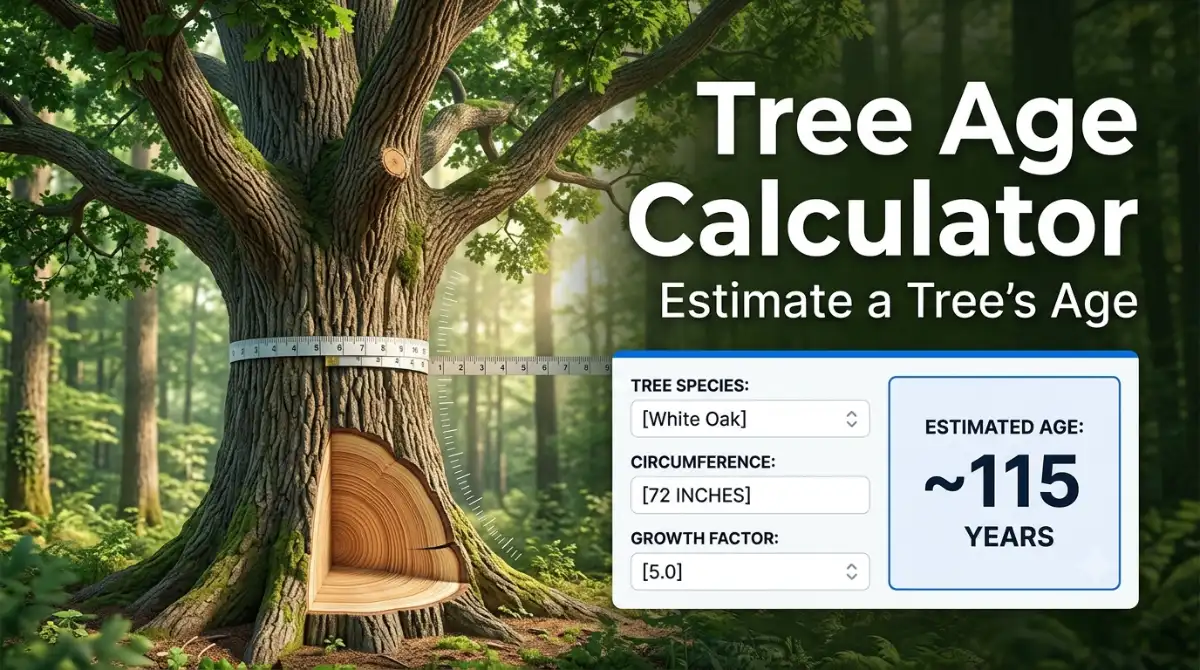
Tree Age Calculator
If you’re looking for a Tree Age Calculator, you can estimate how old a tree may be by using its species and trunk measurement. Enter the required information below to get a quick age estimate based on commonly used tree growth factors in the United States.
Measure the trunk at about 4.5 feet above ground level.
This result is an estimate. Actual tree age can vary because growth depends on species, climate, soil, water, competition, health, and growing conditions.
How Does a Tree Age Calculator Work
Estimating a tree’s age used to mean cutting it down and counting rings. Today, a tree age calculator lets you gauge age with just a tape measure and some math. These tools ask for simple inputs like trunk circumference or diameter and tree species, and then use a formula to calculate the age. For example, one common method converts circumference to diameter and multiplies by a species growth factor. This approach provides a quick age of tree estimate without harming the tree.
How to Use the Tree Age Calculator
Using a tree age calculator is easy and friendly. First, measure the tree’s trunk at about chest height (4.5 feet above the ground). Wrap a flexible tape measure around the trunk and note the circumference in inches. Next, select your tree species and enter any additional info (like growing conditions). Then simply enter the measurements into the calculator tool and press calculate. The calculator will show the tree’s estimated age based on those inputs.
How to Calculate the Age of a Tree
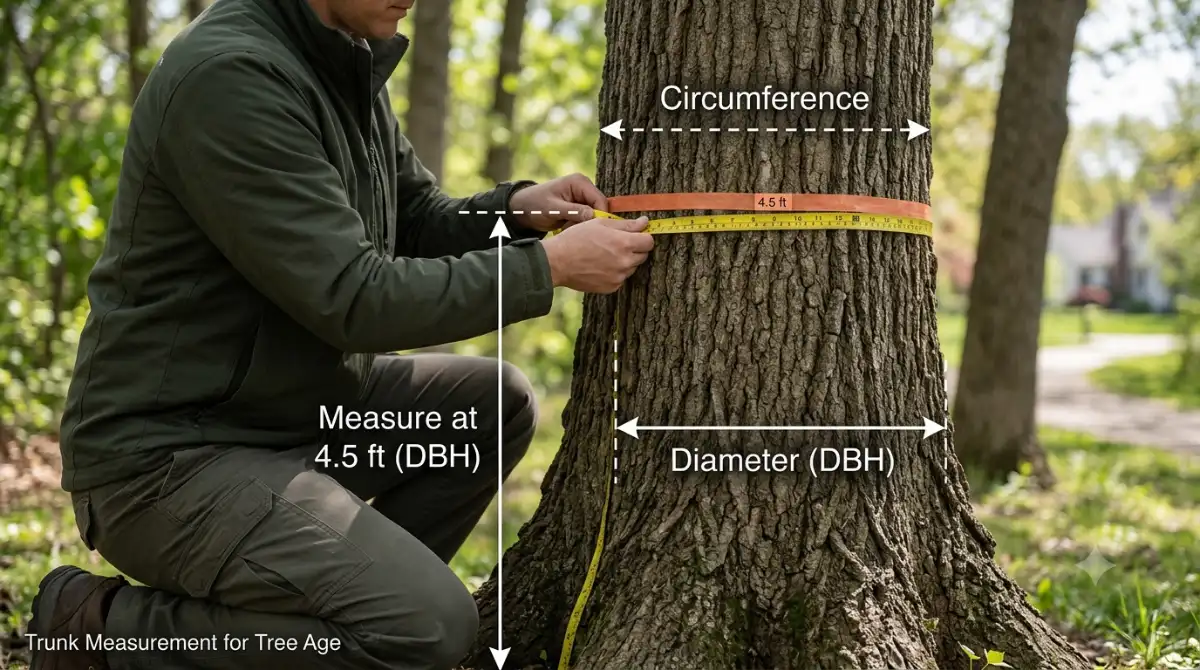
To calculate the age of a tree, start by converting measurements into tree diameter and growth rate terms. After measuring circumference, divide that value by π (approximately 3.14) to get the trunk’s diameter. Then multiply this diameter by the tree species’ growth factor (a number that reflects how fast it grows) to get the tree’s age in years. For example, if a tree is 10 inches in diameter and has a growth factor of 4, its estimated age is 40 years (10 × 4).
For standard DBH guidance, see the USDA Forest Service guide.
Tree Age Calculation Formula
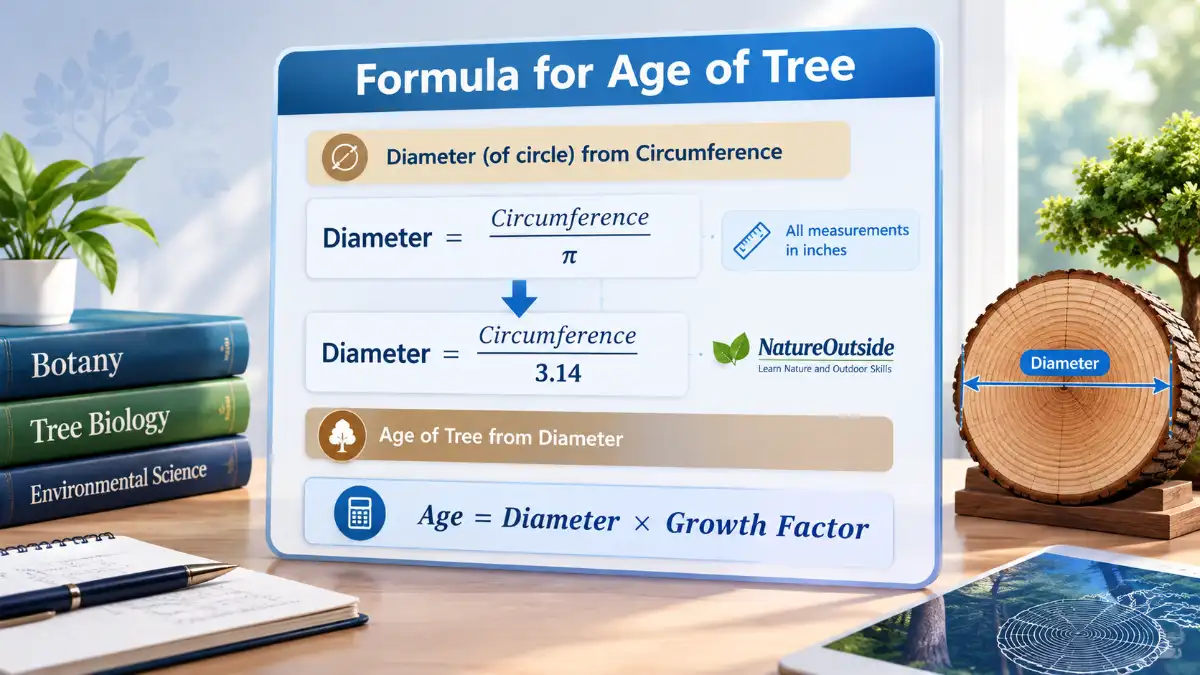
The tree age calculation formula is straightforward. It is usually written as: Age = (Circumference ÷ π) × Growth Factor. You can also think of it as Age = Diameter (inches) × Growth Factor once you have the diameter. In these formulas, circumference is the tape-measured size of the trunk, π is about 3.14, and the growth factor is a species-specific constant based on tree ring research. Using this formula keeps things simple: just plug in your tree’s measurement to get an age estimate.
How to Calculate Tree Age by Circumference
One common way to calculate tree age is by using the trunk circumference. First, measure the tree circumference at breast height (about 4.5 feet up) as described above. Once you have the circumference in inches, divide by π to convert to diameter. Then multiply by the growth factor for that species. For example, if a tree’s circumference is 31.4 inches, dividing by 3.14 gives a 10-inch diameter, and with a growth factor of 4, the tree’s age is about 40 years.
Tree Age Calculator by Tree Species
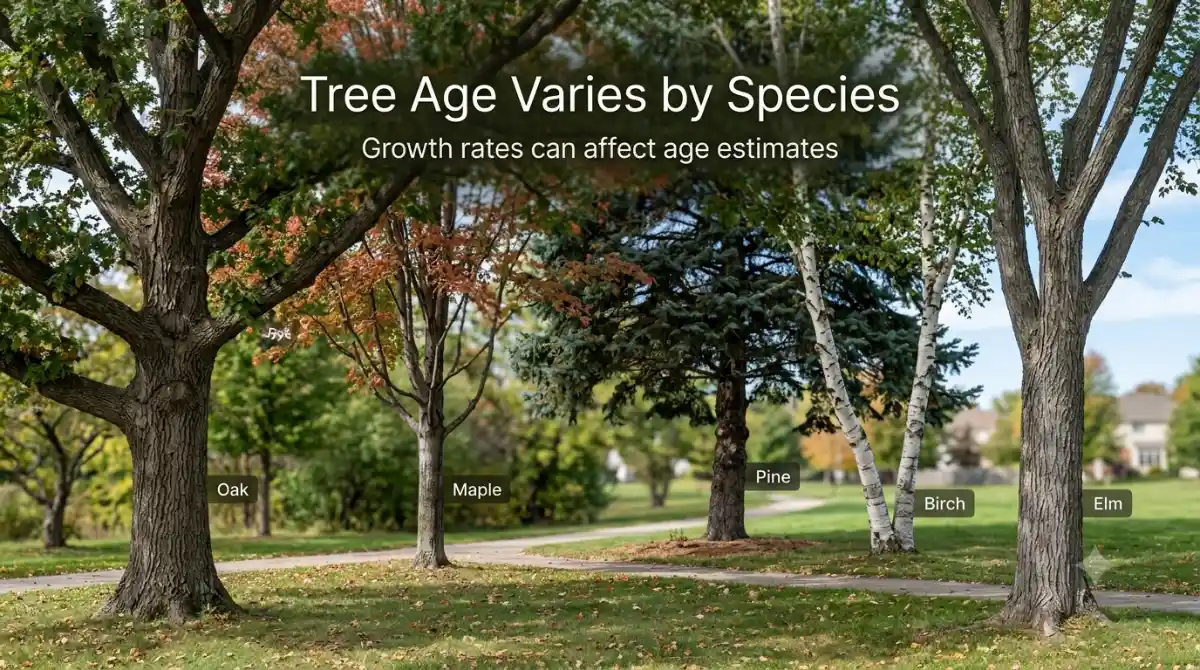
Different tree species grow at different rates, so knowing your species is important. Each species has its own growth factor. For example, many oaks use a factor around 4, while a fast-grower like a Littleleaf Linden might use a higher number. If you use the wrong species, your age estimate can be very different. For example, a 24-inch oak trunk might be roughly 120 years old, but a 24-inch silver maple could be only 40–50 years old. Many online tree age calculators have drop-down lists or fields to select species or input a growth factor.
Oak Tree Age Calculator
Oak trees are famous for living a very long time. In fact, “oak trees grow slowly, and many live for centuries”. Because of their slow growth, even a large oak can be very old. If you enter a big oak’s measurements into a tree age calculator, you’ll usually get an age in the high decades or low hundreds. For example, a 24-inch diameter oak with a factor of 4 would estimate to about 96 years (24 × 4). In reality, some oaks in good conditions might be even older than the calculator suggests.
How Accurate Is a Tree Age Calculator?
Figure: Measuring a tree trunk’s diameter with a tape measure to help calculate its age (photo via Arborist Halifax).
A tree age calculator gives an educated guess, not an exact number. Its accuracy depends on precise measurement and the right data. For best results, measure the trunk carefully and use the correct species or growth factor. Conditions affect growth too: trees in rich soil with plenty of water grow faster, so calculators often let you specify if conditions are “good” or “poor.” Even with perfect inputs, remember that only counting rings gives a truly exact age. Still, it’s a useful tool for gardeners and homeowners.
For more tree growth information, visit the USDA Forest Service.
How Old Is My Tree?
To find out “how old is my tree,” start with a tree age calculator and some measurements. After measuring and calculating, you might compare the result with local growth data or nursery records. For a more official answer, check if there are planting records or talk to an arborist. An arborist can use a tool called an increment borer to take a small core sample and count growth rings without cutting down the tree. Otherwise, your calculator result is a good ballpark age. Remember, factors like weather or pruning can influence growth, so the result is still an approximation.
Figure: A cross-section of a cut tree showing annual growth rings for each year (image via Wikimedia Commons).
Tree Age Calculator vs. Counting Tree Rings
A tree age calculator is non-destructive and quick, but counting tree rings (dendrochronology) is the true method. With ring counting, each year’s growth adds a ring to the wood, so counting rings gives the exact age. You need a cross-section or core sample to see the rings, which may not always be possible. In contrast, a calculator uses circumference and species to approximate age. Diameter typically increases fairly predictably over time, so trunk-based estimates are often reliable. In practice, tree age calculators provide a useful age range without harming the tree.
Learn more about tree-age research from the US Forest Service.
Can You Find the Exact Age of a Tree?
In general, you cannot know a tree’s exact age without cutting or coring it. A tree age calculator always gives an approximation. To find the precise age, an expert would count the growth rings in a core sample. Even this can be tricky if the tree is very old or hollow inside. If a tree was planted recently or under known circumstances, that history gives an exact answer. But in most cases, we rely on estimates. Exact age is rarely known without scientific methods or records.
Final Thoughts on Calculating Tree Age
Using a tree age calculator is a great first step to estimate a tree’s age. By measuring the trunk and using a species factor, anyone can discover a tree’s approximate age quickly. Remember, results are estimates: only counting rings or having planting records yields exact ages. However, for home gardens and schools, a calculator provides a friendly way to learn about a tree’s timeline. So grab a tape measure and try it out – you might be surprised what history is hiding in your trees.
Frequently
Asked Questions
Use a soft tape at about 4.5 feet off the ground (breast height) to wrap evenly around the trunk. Record the inches. For trees on a slope, measure from the uphill side. If the trunk forks below 4.5 feet, measure the main stem or smallest significant stem to avoid confusion.
It helps. Each species has a different growth factor. If you cannot identify your tree, pick a close match or use an average factor (many calculators suggest 3–5). The closer the species, the more accurate the age estimate.
This height is a forestry standard called DBH (Diameter at Breast Height). Measuring at a consistent height makes comparisons fair and helps formulas remain valid.
Measure each main trunk separately. Usually, you use the largest trunk for age estimates. If a tree forks below 4.5 feet, measure the smallest main stem to avoid overestimating age.
Height can give a rough idea, but it is much less reliable. Many trees stop gaining height long before they reach old age, while the trunk keeps widening. That is why diameter (circumference) is used by age calculators.
Growth factors come from research (ring counts vs. trunk size). Common factors are around 3–5. If your calculator has species options, choose the right one. Otherwise start with 4 as a guess and see if the result makes sense.
Yes. A tree in poor soil, drought, or shade often grows more slowly and might be older than its size suggests. Some calculators ask about conditions (good/poor) to tweak the result.
Yes, many gardening and arborist websites offer free calculators. They usually let you input species and measurements to get an age. Just remember these are estimates, not exact ages.
It’s a number representing a species’ average growth rate in trunk diameter (inches per year). For example, a factor of 4 means about 4 inches of diameter per 40 years on average. These are species averages and vary by environment.
Age helps plan care and maintenance. Very old trees may need special attention or permits before pruning. It can also add historical interest or affect property value. Either way, estimating age reveals the story of your landscape.