
Boiler Feed Pump Calculation: 7 Powerful Formulas & Free Calculator
Calculate boiler feedwater flow, total dynamic head, hydraulic power, shaft power, motor size and preliminary NPSH with US and metric units.
1. Boiler & Feedwater Data
2. Pressure & Pump Head
3. Pump & Motor Efficiency
4. Suction & NPSH Check
Boiler Feed Pump Calculation Results
Preliminary Duty Point
Calculation details will appear here.
Boiler Feed Pump Calculation: Flow, Head and Power
Boiler feed pump calculation is used to determine the required feedwater flow, total dynamic head (TDH), hydraulic power, pump shaft power, motor requirement and NPSH for a steam boiler system. The calculator above supports US customary and metric units and provides a preliminary boiler feed pump duty point.
The calculation begins with the maximum steam generation rate and applicable blowdown. It then considers feedwater temperature, density, boiler pressure, suction pressure, elevation, piping losses, pump efficiency and motor efficiency.
- Boiler Feed Pump Flow Calculation
- Boiler Feed Pump Head Calculation
- Boiler Feed Pump Power Calculation
- Boiler Feed Pump Motor Sizing
- Boiler Feed Pump NPSH Calculation
- Boiler Feed Pump Calculation Formula
- Boiler Feed Pump Calculation Example
- Boiler Feed Pump Sizing Checklist
- Frequently Asked Questions
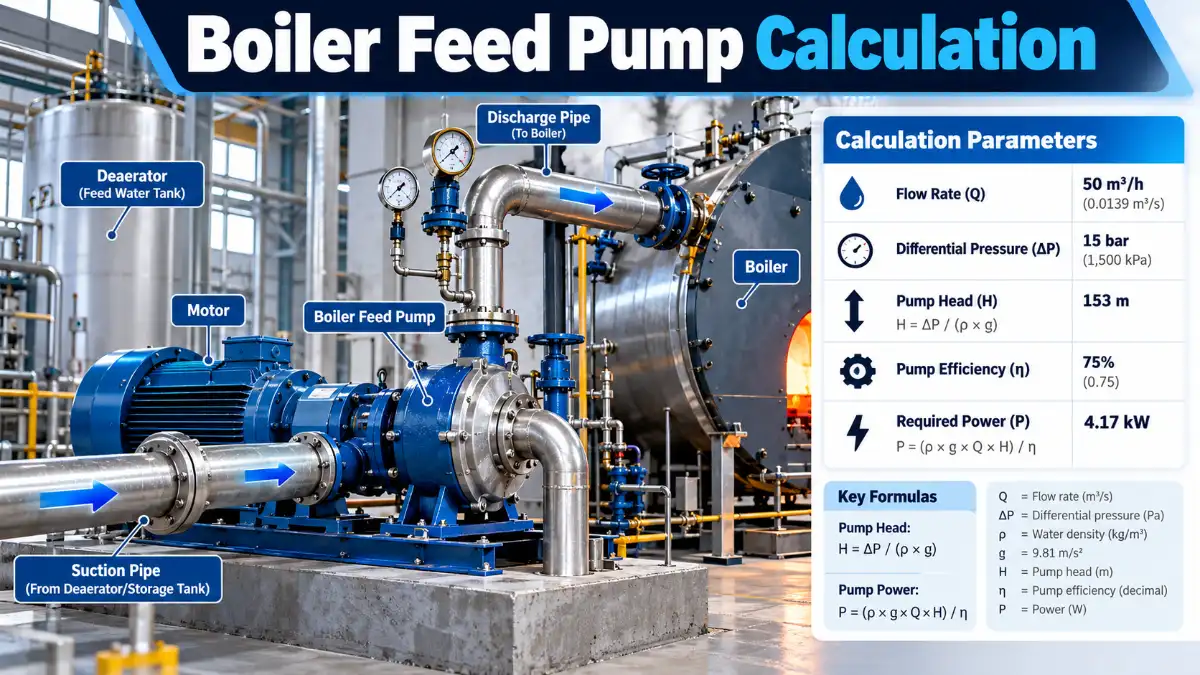
Boiler Feed Pump Flow Calculation
The first step in a boiler feed pump calculation is determining the required feedwater flow. A boiler feed pump must supply enough water to replace the steam leaving the boiler while accounting for continuous blowdown and the selected design margin.
A basic preliminary relationship is:
For example, if a boiler produces 10,000 lb/hr of steam and continuous blowdown is 3%, the approximate feedwater requirement is:
A project-specific flow design margin can then be applied. Feedwater temperature should also be considered because water density changes with temperature.
Boiler Feed Pump Head Calculation
The required boiler feed pump head is determined by the pressure difference between the pump suction and boiler, static elevation, pipe friction and other system pressure losses.
Pressure difference must be converted into liquid head using the feedwater density or specific gravity. A commonly used preliminary relationship for water in US units is approximately 2.31 ft of water head per psi. Hot boiler feedwater has a lower density than cold water, so actual operating conditions should be considered for final design.
Boiler Feed Pump Power Calculation
After the required flow and total dynamic head have been determined, hydraulic power can be calculated. Hydraulic power represents the useful power transferred from the pump to the feedwater.
Where ρ is feedwater density, g is gravitational acceleration, Q is volumetric flow and H is total pump head.
Because a real pump has hydraulic and mechanical losses, pump shaft power is greater than hydraulic power.
Boiler Feed Pump Motor Sizing
Motor sizing should be based on the pump shaft power at the required operating point. The motor must provide sufficient output for the selected pump while allowing for the project-specific design margin.
Motor electrical input can be estimated using motor efficiency:
The final motor should be checked against the pump manufacturer's performance curve, absorbed power at the operating point, service conditions and applicable electrical requirements.
Boiler Feed Pump NPSH Calculation
NPSH is an important part of boiler feed pump sizing because feedwater is often hot and can have significant vapor pressure. The available suction head should be sufficient compared with the pump's required NPSH at the actual operating flow.
NPSHa depends on the absolute pressure above the liquid, liquid level, feedwater temperature, vapor pressure and suction piping losses.
The calculator provides a preliminary NPSHa check. The actual pump manufacturer's NPSHr curve should always be used for final pump selection.
Boiler Feed Pump Calculation Formula
The following equations are used for the preliminary calculation:
| Calculation | Formula |
|---|---|
| Feedwater Flow | Steam × (1 + Blowdown) |
| Volumetric Flow | Mass Flow ÷ Density |
| Total Dynamic Head | Pressure Head + Static + Friction + Other Losses |
| Hydraulic Power | ρ × g × Q × H |
| Pump Shaft Power | Hydraulic Power ÷ Pump Efficiency |
| Electrical Input | Shaft Power ÷ Motor Efficiency |
| Motor Requirement | Shaft Power × (1 + Motor Margin) |
Boiler Feed Pump Calculation Example
Consider a steam boiler producing 10,000 lb/hr of steam with 3% continuous blowdown. Assume 150 psig boiler pressure, atmospheric feed tank pressure, 194°F feedwater temperature, 15 ft static elevation, 25 ft friction loss and 5 psi additional pressure loss.
For this example, a 15% flow design margin, 10% head margin, 70% pump efficiency and 92% motor efficiency can be entered into the calculator.
The calculator first determines the feedwater mass flow, converts it to volumetric flow using the estimated feedwater density, calculates the pressure head and adds static and hydraulic losses.
Hydraulic power is then calculated from flow and head. Pump efficiency is used to estimate shaft power, while motor efficiency is used to estimate electrical input.
These values are suitable for preliminary engineering estimation. Final pump selection should use the actual manufacturer's pump curve and certified performance data.
US Units and Metric Units
This boiler feed pump calculation tool supports both US customary and metric engineering units.
| Parameter | US Unit | Metric Unit |
|---|---|---|
| Steam Generation | lb/hr | kg/h |
| Pump Flow | GPM | m³/h |
| Pump Head | ft | m |
| Pressure | psi | bar |
| Power | HP / kW | kW |
| Temperature | °F | °C |
| NPSH | ft | m |
Boiler Feed Pump Sizing Checklist
Before selecting a boiler feed pump, verify the complete system design rather than relying only on boiler capacity.
- Maximum boiler steam generation
- Continuous blowdown requirement
- Feedwater temperature
- Feedwater density
- Boiler operating pressure
- Deaerator or feed tank pressure
- Static elevation
- Pipe friction losses
- Control valve pressure drop
- Economizer pressure drop
- Pump efficiency
- Motor efficiency
- NPSHa
- Pump NPSHr
- Minimum flow requirement
- Maximum operating flow
- Pump performance curve
- Motor service conditions
- Applicable project requirements
Related Engineering Calculators
Use the following related engineering resources to complete your pump and boiler calculations:
Engineering Resources
For additional steam and boiler engineering information, consult established engineering and standards organizations.
- Spirax Sarco – Steam Engineering
- ISO – International Standards
- ASME – Engineering Standards and Codes
Frequently Asked Questions
What is a boiler feed pump?
A boiler feed pump supplies treated feedwater to a steam boiler at a pressure high enough to overcome boiler pressure and system pressure losses.
How do I calculate boiler feed pump capacity?
Start with maximum steam generation, add the required blowdown allowance, convert the resulting mass flow into volumetric flow using feedwater density, and apply the appropriate design margin.
How do I calculate boiler feed pump head?
Calculate the pressure head required to overcome the boiler pressure difference, then add static elevation, pipe friction and other system pressure losses.
How is boiler feed pump power calculated?
Hydraulic power is calculated from feedwater density, gravity, volumetric flow and pump head. Dividing hydraulic power by pump efficiency gives an estimate of pump shaft power.
Why is NPSH important for boiler feed pumps?
Hot feedwater can have significant vapor pressure. NPSH available should therefore be checked against the pump manufacturer's NPSH required at the actual operating flow.
What information is needed for boiler feed pump sizing?
Important inputs include boiler steam generation, blowdown, feedwater temperature, boiler pressure, suction pressure, elevation, piping losses, pump efficiency and NPSH requirements.
Final Engineering Note
This boiler feed pump calculation tool is intended for preliminary engineering estimates and educational use. Final equipment selection should be verified against the manufacturer's certified pump curve, NPSHr data, absorbed power, minimum-flow requirements, temperature and pressure ratings, control requirements and applicable project standards.