

AP Human Geography Score Calculator
If you want to estimate your AP Human Geography score, use this simple score calculator to combine your multiple-choice and free-response results. Enter your practice scores below to see an estimated AP score from 1 to 5.
Calculate Your AP Human Geography Score
Enter your scores from a practice AP Human Geography exam.
Your Estimated AP Score
Complete all score fields and select the calculate button to see your estimated AP Human Geography score.
How are you projecting the scoring curve?
We project the AP Human Geography scoring curve using historical exam data and official College Board guidelines. We analyze past multiple-choice and FRQ raw scores to see what composite score produced each 1–5 grade. Because the College Board sets cutoffs differently each year based on test difficulty, our tool uses recent scoring curves as a guide. In other words, the calculator estimates how your raw score would convert into a final AP score by comparing it to past score distributions. This lets you see a projected AP score based on your raw totals.
For official AP Human Geography exam details, see the College Board AP Human Geography exam page.
What is a good AP Human Geography score?
A score of 3 or higher on the AP Human Geography exam is generally considered passing. In the U.S., a 4 or 5 is often needed for college credit and is viewed as strong performance. Many universities grant credit for scores of 4 and 5, while top schools often require a 5. For example, Ivy League colleges typically expect a 5 for credit, but many public universities will accept a 3 or higher. In summary, aim for a 4 or 5 if you want maximum college credit and flexibility, and see 3 as the baseline passing score.
What is the average AP Human Geography score?
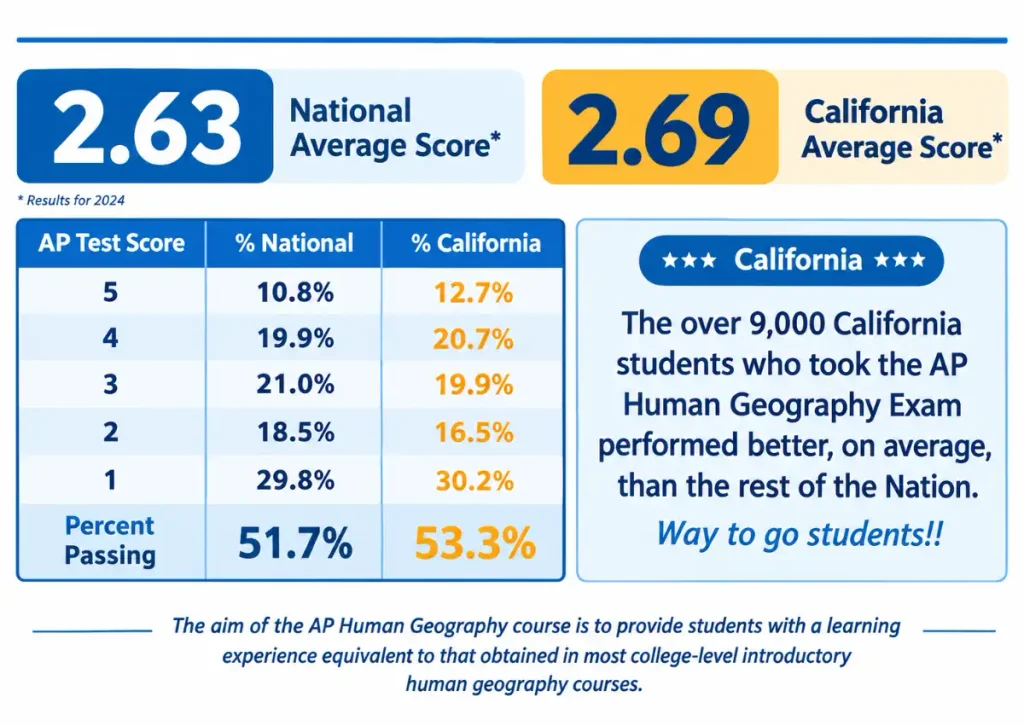
Recent data show the mean score is around the low 3s. For instance, the average AP Human Geography score in 2025 was about 3.13. Historically, roughly 55–65% of students score a 3 or above on this exam. This means just over half of test-takers meet the passing threshold (3 or higher). Keep in mind the average can change each year, but it’s useful to know that a score of 3 is near the middle of the distribution.
Why are AP Human Geography scores curved?
AP exams use a curved scoring system to account for test difficulty. Each AP subject is curved on its own scale each year. This means the raw total needed for a 1, 2, 3, 4, or 5 can shift from year to year. For example, a 5 is always labeled “Extremely Well Qualified,” but the number of raw points needed for that label can change. Our calculator uses historical cutoffs to approximate the curve, but remember that the College Board sets the official curve annually based on how hard the exam was.
Why should I use this AP Human Geography score calculator?
Using an AP Human Geography score calculator gives you quick insight into how your practice scores might translate to the official 1–5 score. You enter your raw multiple-choice and free-response points, and it estimates your AP score using past exam data. This helps you see how close you are to different score goals and which section needs more work. It’s a free, easy way to focus your study efforts, since you know exactly how many more points you need for a higher score.
How to Improve Your AP Human Geography Score
To improve your AP Human Geography score, start by reviewing key units and practicing regularly. For multiple-choice, focus on learning important geographic models and practicing map and chart interpretation; try eliminating obviously wrong answers. For free-response questions, be sure to answer every part: define terms clearly, use specific examples, and keep answers concise. Taking timed practice exams under realistic conditions is also crucial to build speed and confidence. The more you practice and learn from mistakes, the higher your score can go.
For additional practice, visit AP Central's AP Human Geography exam resources, where College Board provides exam information and past scoring resources.
How to Interpret Your AP Human Geography Score
Your AP score (1–5) has a clear meaning. College Board labels a 3 as “Qualified,” a 4 as “Very Well Qualified,” and a 5 as “Extremely Well Qualified”. In practical terms, a 3 is passing and often earns college credit, while a 4 or 5 usually earns stronger credit or placement. For example, at many universities a 3 could let you skip an intro class, while a 4 or 5 might allow placement into higher-level courses. Use your score and these labels to plan next steps, such as choosing courses or study paths. Remember, a 4–5 is ideal for credit at competitive schools, while 3 is the minimum passing goal for most programs.
Conclusion
An AP Human Geography score calculator is a handy tool for students aiming to understand their expected exam results and plan their study. We’ve explained how the scoring curve works and how raw scores map to AP scores and college credit, what scores are considered good, and how to improve and interpret your score. With an estimated score and this knowledge, you can focus your studying on areas that need work and set realistic goals for exam day. Good luck on the exam—you’re now better prepared!
Frequently
asked questions
It’s a free online tool where you enter your raw multiple-choice (MC) and free-response (FRQ) points to get an estimated AP score. It uses past exam data and official scoring rules to predict your score from 1 to 5.
Cutoffs vary each year, but you generally need around 70% of the total points to score a 5. For example, past years required roughly 84 out of 120 composite points (about 70%) for a 5.
No. You earn points only for correct answers, so you should answer every question. There is no deduction for wrong answers.
Your multiple-choice section has 60 questions (max 60 raw points). Each of the 3 FRQs is worth 7 raw points (21 total); this is scaled up to 60 points. The MC score (0–60) plus the scaled FRQ score (0–60) gives a composite out of 120. That composite is then converted to your 1–5 AP score.
It provides a good estimate, but it’s not an official score. Calculators use historical cutoff data as a guide, and the actual College Board cutoffs can shift slightly each year.
AP scores are typically released in early to mid July following the May exam. They come out in waves, so check your College Board account regularly around the release window.
A score of 3 or higher is generally considered passing. Many U.S. colleges award credit or placement for scores of 3, 4, or 5, though policies vary.
You cannot retake the exam within the same school year. If you want to improve your score, you must register and retake it in a future AP exam administration.
Study actively by unit (population, culture, etc.), make flashcards for key terms, and practice with official MCQs and FRQs.
You can find official past free-response questions and scoring information through College Board AP Central.
Focus on understanding models and maps, and practice writing clear, concise answers.The AP score (1–5) indicates how well you met college-level standards. A 3 means “Qualified” (a passing grade), 4 means “Very Well Qualified,” and 5 means “Extremely Well Qualified”. Colleges use these scores for credit or placement decisions, so check your target schools’ policies and plan accordingly.