

COBRA Cost Calculator
Losing a job or having your hours cut can trigger COBRA (the Consolidated Omnibus Budget Reconciliation Act), which lets you keep your employer-sponsored health plan for a time. However, COBRA shifts the full cost of that insurance onto you. In practice, you pay 100% of the premium (both your share and your old employer’s share) plus a small administrative fee. A simple COBRA cost calculator or formula can show exactly how much that will be. In this guide we explain how to estimate your COBRA insurance premium, break down the fees, and compare it to other coverage options.
Calculate Your COBRA Cost
Enter your monthly coverage amounts below to get an estimated COBRA premium.
Your previous monthly contribution toward the health plan.
The amount your employer previously paid toward your coverage.
Enter 0%–2%.
Select your estimate period.
Your Result Will Appear Here
Enter all required information and click Calculate COBRA Cost.
Estimated COBRA Cost
How to Calculate COBRA Cost
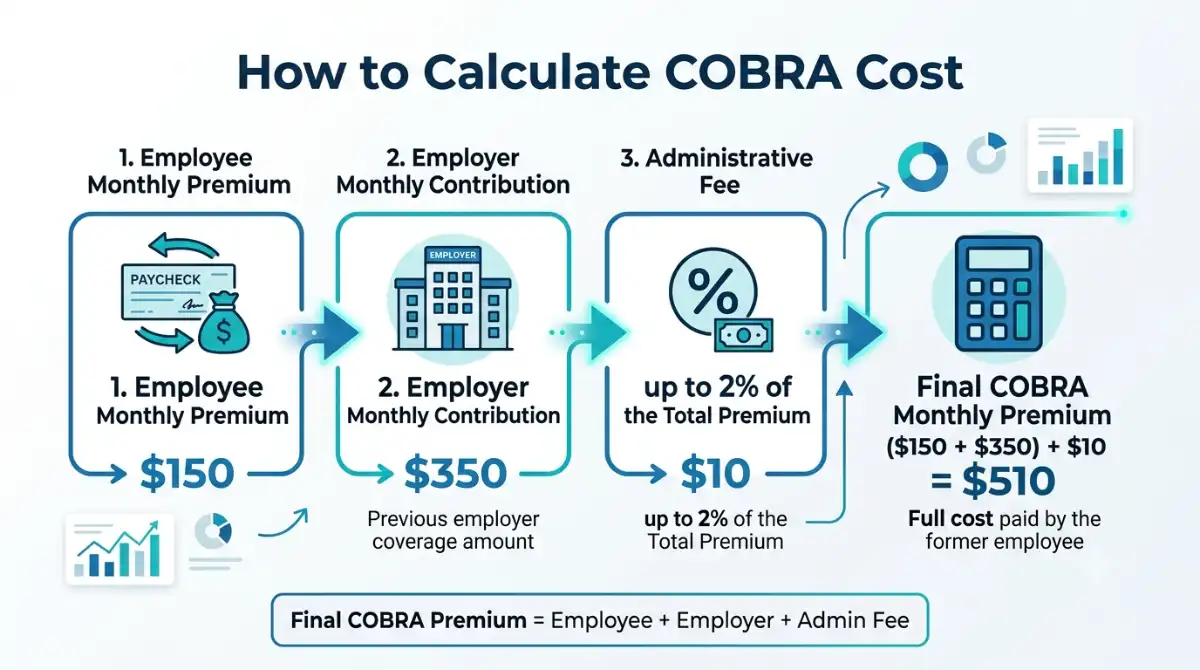
To calculate your COBRA cost, first find your full premium – that is, the total monthly premium for your health plan. Your employer’s portion and your portion together make up this full premium. For example, if your payroll deduction was $150 and your employer paid $550, the full plan premium is $700. Your COBRA monthly premium equals the full premium plus a small administrative charge (up to 2%). In practice that means multiplying the full premium by about 1.02 (for a 2% fee). So in our example you would pay about $714 per month on COBRA ($700 + 2% fee). Finally, multiply the monthly figure by the number of months you plan to stay on COBRA (usually 18 or 36) to get the total.
How Much Does COBRA Insurance Cost?
COBRA costs vary widely by plan and family size. On average in 2024–2026 a single person’s COBRA premium is roughly $400–$700 per month. If you’re covering a spouse and children, your family COBRA premium can easily exceed $1,500 per month. These are national averages; your exact cost depends on your specific health plan. Remember, COBRA simply continues your most recent employer plan, so the premium is the actual plan cost you were already enrolled in. In other words, COBRA is not a cheap short-term policy – it’s the full employer plan, which is why it tends to run several hundred dollars a month.
COBRA Insurance Cost Per Month
In practical terms, your COBRA monthly cost will be about 102% of your old plan’s premium. That is, you add up what you and your employer used to pay, and tack on a 2% admin fee. Because employers usually paid the larger share, COBRA premiums often feel like a big jump. For example, if the full premium was $700 and you had been paying $150, COBRA would cost about $714 per month (the entire $700 plus 2% fee). That means your out-of-pocket goes from $150 to $714 every month – a jump of $564. Monthly COBRA costs can vary, but this calculation (employee share + employer share, plus admin fee) is how you get your number.
What Does COBRA Cost Include?
Your COBRA premium covers the same benefits as before under your employer’s plan, but includes the entire cost. In other words, you keep the same doctors, deductibles, and coverage, but now you pay what the employer used to pay plus a small fee. Specifically, it includes: 1) the full health plan premium (both your old share and your employer’s share); and 2) an administrative fee of up to 2% of that total. No new benefits are added – you’re simply carrying the same plan yourself. For disability extensions beyond 18 months, the law allows a higher fee (making the premium as much as 150% of the plan cost for those extra months). But in normal COBRA coverage you’ll generally see up to 102% of your plan’s total premium as your monthly bill.
Can You Calculate COBRA Cost From Your W-2 or Paycheck?
Yes. The quickest way is to check your recent pay stub or benefits portal to see how much you (the employee) were paying in premiums. You’ll also need the employer’s share. If you don’t have the employer’s share handy, you can find the full premium on your last year’s W-2 Form. Box 12 of the W-2, marked with Code DD, shows the total annual cost of your employer-sponsored health coverage. Divide that Box DD amount by 12 to get your monthly full premium. Then subtract your portion (from your pay stub) to find the employer portion. Finally, apply the 2% fee on the total to calculate your COBRA premium. In practice, experts say using your pay stub and Box DD on W-2 are the quickest sources for this calculation.
COBRA Cost Calculation Example
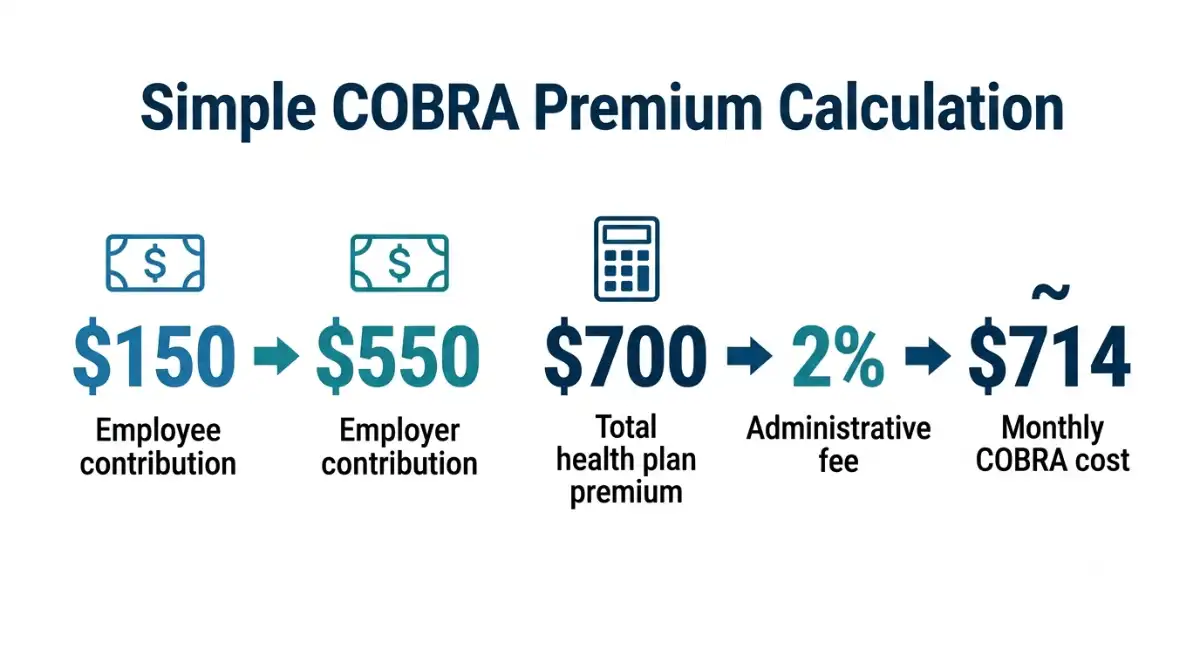
For example, suppose your health plan’s total monthly premium is $700 and you had been paying $150. In that case, your COBRA premium would be $700 plus a 2% fee, which is about $714 per month...
For example, suppose your health plan’s total monthly premium is $700 and you had been paying $150. In that case, your COBRA premium would be $700 plus a 2% fee, which is about $714 per month. That shows you were previously heavily subsidized – under COBRA you now cover the entire $700. Over a typical 18-month COBRA period, that $714/mo adds up to roughly $12,852 in total premiums. In other words, what looked like a $150 commitment at work becomes more than $12,800 of payments when continued through COBRA. This illustrates why it’s important to run the numbers: COBRA can be much pricier than the paycheck deduction you were used to.
Why Is COBRA Insurance So Expensive?
COBRA is often seen as expensive because it removes the employer subsidy. When you were employed, your paycheck premium was only a portion (often 20–30%) of the total plan cost. Your employer paid the rest. Under COBRA you pay the entire premium, so it feels like a huge jump. For instance, one analysis shows the average single-coverage premium was $703 per month in 2023, but workers only paid about $117 of that. On COBRA, that same person would pay roughly $717 ($603 + 2%). The plan’s benefits haven’t changed – only who’s paying. In summary, COBRA isn’t adding hidden markups, it’s charging the full cost of the plan (your old subsidy included) plus a small admin fee, which is why the sticker shock is real.
COBRA vs. Marketplace Insurance Cost

When you lose job-based coverage, you’re eligible for a 60-day special enrollment period to join a Health Insurance Marketplace plan (Affordable Care Act plan). This means you can compare COBRA and Marketplace prices directly. Often, subsidized Marketplace plans are much cheaper than COBRA. People with low to moderate income may qualify for premium tax credits that reduce or even eliminate their monthly premium. In practice, many find that the ACA marketplace cost is far less than their COBRA bill. That said, COBRA’s upside is continuity – same coverage, same provider network, and you keep any deductible progress. The Marketplace route might save money, but it could mean switching doctors or starting over on deductibles.
If you lose job-based health coverage, you may also be able to enroll in Marketplace coverage during a Special Enrollment Period. See HealthCare.gov Marketplace coverage for official information about your options.
Which Is Cheaper: COBRA or Marketplace Insurance?
In most cases, a subsidized Marketplace plan is cheaper than COBRA, especially if your income is low enough for tax credits. By law, losing job coverage triggers a Marketplace special-enrollment opportunity, so you can shop competitive plans. COBRA becomes relatively less attractive when you can get significant subsidies. However, if you earn too much to get ACA credits, or if your employer’s plan was unusually low-cost, COBRA might sometimes be comparable. Ultimately, the best approach is to price both options. Many experts recommend plugging your numbers into a COBRA vs. Marketplace calculator to see which gives you a lower monthly premium. Generally though, with subsidies the Marketplace wins on price for most families.
How Long Can You Have COBRA?
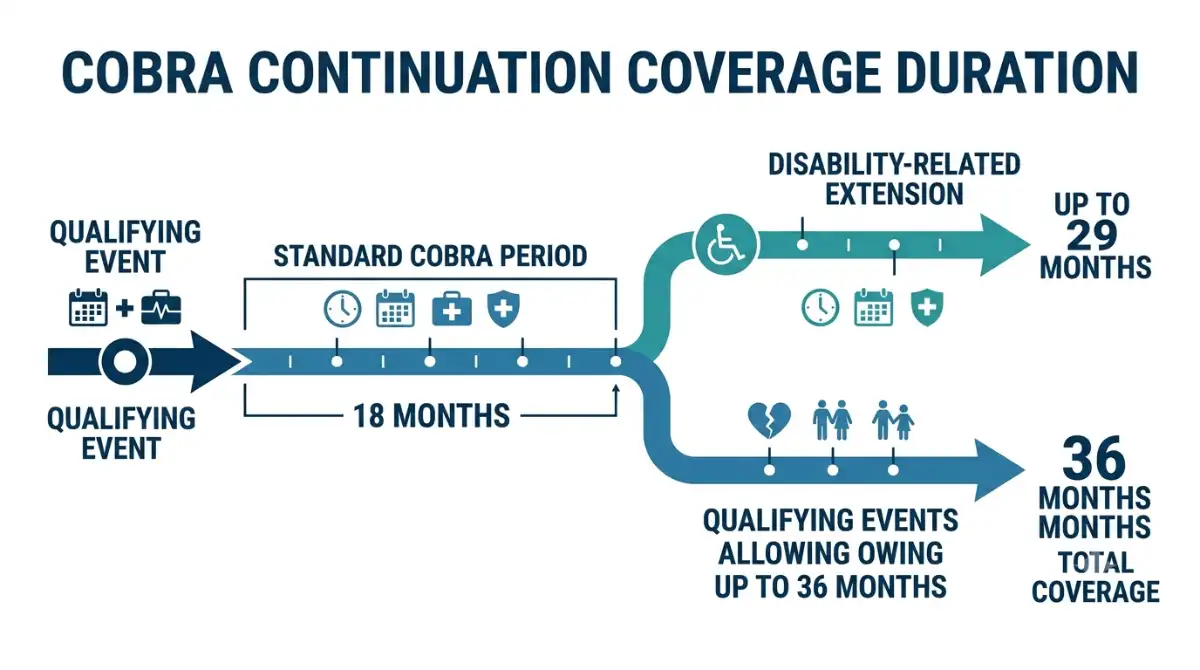
Federal law sets the duration. For most qualifying events...
Federal law sets the duration. For most qualifying events (like involuntary job loss or reduction of hours), COBRA coverage can last up to 18 months. Certain other events extend coverage to 36 months – for example, if you divorce or legally separate, if the covered employee dies, or if a dependent child loses eligibility (turns 26). Additionally, if a Social Security–certified disability affects anyone in the family, you can get an extra 11 months on top of 18 (29 months total), although those additional months may cost 150% of the premium. After the maximum period ends, COBRA coverage ceases. Remember to check exactly how many months apply to your situation, as it depends on the qualifying event.
For more information about COBRA continuation periods and qualifying events, review the official COBRA coverage rules from the U.S. Department of Labor.
What Information Do You Need to Calculate COBRA Cost?
To run the math, gather a few key pieces of information. You’ll need your old employee premium (the amount you paid each paycheck) and your employer’s premium share. Your paystub or benefits portal typically shows your deduction. To find the employer’s share, your W-2 is helpful: Box 12 code DD has the total annual premium. Divide that by 12 to get the full monthly premium. Also note your COBRA administrative fee percentage (up to 2%). Finally, know the number of months you’ll want COBRA (usually 18 or 36). With those figures (your share, employer share, admin fee, months), you can calculate your monthly and total COBRA cost.
What Is the COBRA Administrative Fee?
The COBRA administrative fee is a small extra charge plans can add on top of your premium. Federal law lets employers or plans tack on up to 2% of the premium For detailed federal guidance about COBRA premiums and continuation coverage, visit the U.S. Department of Labor COBRA guide.
Frequently Asked Questions About COBRA Cost
Even after you do the math, questions can come up. For instance, when do I need to sign up? You generally have 60 days from the date you lose coverage (or from when you receive the COBRA election notice) to elect coverage. Another common question: Does COBRA coverage stay the same? Yes – it’s the same plan, same benefits, and you continue with the same deductible and network. COBRA also covers your eligible dependents (spouse and children) if they were on the plan. One more: Are there subsidies or discounts? Under normal rules, no – COBRA has no ongoing federal subsidy (except rare one-time programs in the past), so you cover the full premium. If cost is a concern, compare a Marketplace plan, which may offer tax credits and potentially lower monthly payments. In all cases, check with your plan administrator for details on deadlines and premium amounts, since specific rules can vary.
Disclaimer
This information is intended as a general guide to estimating COBRA costs. It is not financial or legal advice. Rules and premiums can vary by plan and state. Always double-check with your plan administrator, benefits coordinator, or official resources (like the Department of Labor or HealthCare.gov) for exact calculations and deadlines. Premiums and fees can change, so treat this as an educational overview. The final decision on COBRA enrollment and payment timing is yours, and it may help to consult a professional if you have questions about your personal situation.
Frequently Asked Questions About COBRA Cost
A COBRA Cost Calculator is a simple tool that helps you estimate what you may pay to continue your employer-sponsored health insurance after losing job-based coverage. Unlike your old payroll deduction, the estimate usually includes the full health plan premium that your employer previously helped pay. A standard COBRA premium can also include an administrative fee of up to 2%. Your actual amount depends on your specific health plan and the coverage you choose.
To calculate COBRA cost, start with the total monthly premium for your employer health plan. This includes both your previous contribution and your employer's contribution. Then add the applicable COBRA administrative fee, which can be up to 2% for standard COBRA coverage. For example, if the full monthly premium is $600, a 2% fee would add $12. Your estimated COBRA premium would then be $612 per month.
COBRA insurance cost depends on the plan and the number of people covered. There is no single monthly price for everyone. As a general example, individual coverage can cost several hundred dollars per month, while family coverage can reach or exceed $1,500 per month. The key point is that you normally pay the full group health plan premium instead of only the portion that came out of your paycheck.
Yes. Your W-2 can help you estimate the total cost of your employer-sponsored health coverage. Look at Box 12, Code DD, which reports the annual cost of employer-sponsored health coverage. Divide that amount by 12 to get an approximate monthly figure. You can then account for the COBRA administrative fee. However, use your COBRA election notice or plan administrator's information for the final premium because the W-2 figure is not itself a COBRA bill.
Your COBRA insurance cost may look surprisingly high because your employer no longer pays its usual share of the health plan premium. While you were working, your paycheck deduction represented only your portion of the premium. Under COBRA, you generally pay both your former share and the employer's share. The plan may also charge an administrative fee of up to 2%. The coverage itself does not suddenly become more expensive. You are simply responsible for more of the existing plan cost.
Not always. In many cases, a Marketplace plan can cost less, especially if you qualify for premium tax credits. However, price is only one factor. COBRA allows you to continue your existing employer health plan, which can be useful if you want to keep the same doctors, network, benefits, or deductible progress. When you lose job-based coverage, compare your COBRA premium with available Marketplace plans before making a decision.
For many qualifying events, federal COBRA coverage can last for up to 18 months. Certain situations can allow longer coverage. For example, some qualifying events involving a spouse or dependent can provide up to 36 months of continuation coverage. A disability extension may also extend certain coverage periods. Your exact eligibility and maximum coverage period depend on the qualifying event and the plan's rules, so check your COBRA election notice for details.
You usually need a few basic details. Start with the full monthly premium for your health plan. You can find this through your benefits portal, plan documents, COBRA election notice, or other information from your employer or plan administrator. Your pay stub can show your previous contribution. Your W-2 may also help you estimate the total annual cost. Finally, check the applicable administrative fee and the number of months you expect to keep coverage.
The COBRA administrative fee is an additional amount that a plan may charge for administering continuation coverage. For standard COBRA coverage, federal rules generally allow a fee of up to 2% of the applicable premium. That means a plan costing $800 per month could have a maximum standard COBRA charge of about $816 if the full 2% fee applies. Certain disability extension periods can have different rules and may allow a higher charge.
Yes. A COBRA Insurance Cost Calculator can give you a quick estimate before you make a coverage decision. It helps you see the difference between your old payroll deduction and the full COBRA premium. You can also compare that number with Marketplace plans, including any available financial assistance. The calculator is best used as an estimate. For the exact amount, always check your official COBRA election notice or contact your plan administrator.