
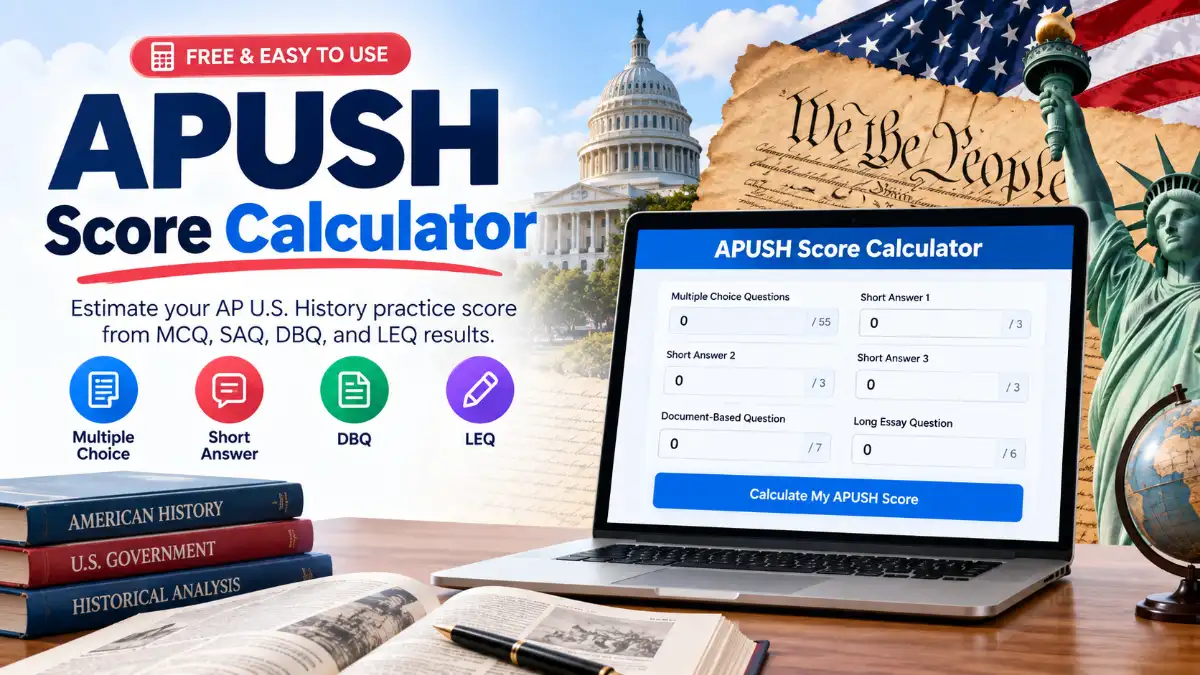
APUSH Score Calculator
The APUSH score calculator shows how each part of the AP United States History exam affects your final result. The test includes multiple-choice questions, short-answer questions, a document-based question, and a long essay, with each section assigned a different weight. Checking your performance section by section can reveal what you already handle well and where more practice would help. This guide covers the current scoring system, explains the weight of each major section, and offers practical ways to read practice scores and prepare before test day.
What Is an APUSH Score Calculator?
An APUSH score calculator turns practice-test results into a rough estimate of an AP U.S. History score. It becomes most useful after a full practice exam, when a raw point total alone cannot show how you performed across the test’s sections. A reliable calculator accounts for the different weights of multiple-choice questions, short-answer questions, the Document-Based Question (DBQ), and the Long Essay Question (LEQ). Treat the result as a study reference, not a promise of your official score; College Board scoring rules and annual score-setting decisions can change the final outcome.
How the APUSH Exam Is Scored
The AP United States History exam tests factual knowledge alongside historical reasoning. The College Board assigns 40% of the total score to multiple-choice questions and 20% to short answers. Free responses make up the other 40%: the document-based question counts for 25%, while the long essay accounts for 15%. Knowing this breakdown helps when using an AP US History score calculator
APUSH Multiple-Choice Questions
Multiple-choice questions make up 40% of the APUSH exam score, so they deserve a serious place in any study plan. They test more than memory: students may need to read primary or secondary sources, place events in context, trace causes and effects, compare developments, or use evidence to recognize larger historical patterns. After checking a practice test with an APUSH score calculator, look beyond the raw number correct and examine what kinds of questions caused trouble.
APUSH Short-Answer Questions
Short-answer questions make up 20% of the APUSH score. Students need to answer the historical prompt directly, using accurate evidence and clear reasoning rather than padding their responses with extra detail. Good preparation means recognizing the historical development under examination, choosing evidence that fits, and explaining its connection to the answer. If practice results reveal a weakness here, an APUSH calculator can show how stronger short answers might raise the overall score.
APUSH Document-Based Question
The document-based question, or DBQ, accounts for 25% of the AP U.S. History (APUSH) exam. Students must build a persuasive historical argument from the documents while showing that they understand the larger context. Strong responses usually include a clear thesis, effective use of the documents, relevant outside evidence, and an explanation of why that evidence matters. Summary alone will not do; each document should support the argument the student is developing. For that reason, practicing DBQs can be especially useful when preparing for the AP U.S. History exam and gauging likely performance from practice scores.
APUSH Long Essay Question
The long essay question (LEQ) accounts for 15% of the AP U.S. History (APUSH) exam score. Students must make a historical argument and support it with relevant evidence. Strong responses present a defensible thesis, use accurate evidence, and explain how that evidence supports the main claim. Practice across different periods and themes helps students handle unfamiliar prompts with greater confidence.
How an APUSH Score Calculator Helps With Practice
An APUSH score calculator does more than estimate a final result. Its real use is turning practice performance into a study plan. A student who handles multiple-choice questions well but struggles with written responses should spend more time building historical arguments and supporting them with evidence. Someone else may write convincingly yet misread sources and lose points there. Looking at each section separately helps students focus their preparation instead of reviewing material they already understand.
Understanding Your APUSH Score Estimate
Treat a practice score as a rough estimate, not a prediction. The College Board calculates AP scores through a specific process, so your raw performance does not convert directly into a percentage or a final score from 1–5. An APUSH score calculator can still show whether your preparation is moving in the right direction. If the estimate changes from one practice test to another, compare how you performed in each section before deciding whether you have improved.
What Does a 5 on APUSH Mean?
A 5 is the top score on the AP United States History exam and reflects exceptional performance. That score does not automatically guarantee college credit, though; colleges and universities set their own rules for AP credit and course placement. Before factoring an APUSH score into college plans, check the policies of each school under consideration. For current details about AP scoring and exam requirements, consult the College Board’s official resources.
APUSH Score Distribution
Score distributions provide useful context, but they cannot predict your personal result. Recent College Board reports show AP United States History scores ranging from 1 to 5, with many students earning a 3 or higher. Your score comes from how you perform on the exam—not from how many other students receive a particular score. If you use an AP US History score calculator, focus on answering accurately, supporting your reasoning with evidence, and managing your time rather than comparing yourself too closely with national results.
APUSH Units You Should Review
AP United States History follows the country’s development from about 1491 to the present. Its nine major units cover Indigenous societies and European colonization, the Revolution and early republic, westward expansion, the Civil War and Reconstruction, industrialization and the Progressive Era, World War II, the Cold War, and events from 1980 onward. Study time is best spent first on the units connected to your weakest areas; reviewing those topics closely is more efficient than giving every chapter equal attention.
APUSH Historical Thinking Skills
APUSH tests more than historical knowledge. Students must read sources in context, connect developments, explain why events happened, compare changes over time, and support their claims with evidence. Those skills shape both the multiple-choice section and the free-response questions. An APUSH calculator can help, but it should accompany practice that builds historical reasoning—not replace it with memorization.
How to Improve Your APUSH Practice Score
Start with the topics where you keep losing points. On multiple-choice questions, review every wrong option and figure out why it fails—not just why the right answer works. For short responses and essays, make a clear claim, then support it with precise historical evidence. With Document-Based Questions (DBQs), use the documents to build your argument rather than summarizing them one by one. Repeat this review after every practice test; each result gives your APUSH score calculator better feedback for the next study session.
Use Official College Board Resources
Students should always compare third-party calculator estimates with current information from the College Board AP United States History course page and the official APUSH assessment information. College Board provides the authoritative information about the exam structure, course expectations, assessment updates, and AP scoring. Third-party calculators such as an AP United States History Calculator are best used for practice and planning, not as a replacement for official score reporting.
APUSH Exam Timing and Time Management
Managing time well matters on the APUSH exam. Students must handle different question types while working against a fixed 3-hour-and-15-minute testing period, according to the College Board’s latest assessment information. The multiple-choice section takes 55 minutes; the short-answer and free-response portions require students to divide the remaining time across several tasks. Practice with those limits in place, and an APUSH score calculator will give you a more reliable estimate because your results will better reflect the actual test.
Why Your Raw Score Is Not Your Final AP Score
Many students assume their raw percentage maps directly to an AP score, but that is not how AP exams are graded. The exam uses a conversion process that turns a student’s performance into a final score from 1 to 5, and the conversion may vary. A single raw-score percentage, then, should be treated as an estimate rather than an official result. An AP US History calculator can predict a score using an assumed scoring model; the College Board issues the official score only after grading is complete and the results are released.
Best Way to Use an APUSH Score Calculator
Before you use an APUSH score calculator, take a full practice exam under realistic conditions. Record your multiple-choice score, complete the written sections, and grade them using the appropriate guidelines. Then compare your estimates with the questions you missed and the skills those questions tested. Patterns in your mistakes will show you where to focus. Reviewing the exam this way works far better than checking a projected score and moving on.
Other AP Calculators on Calquza
Frequently Asked Questions About the APUSH Score Calculator
What is an APUSH score calculator?
An APUSH score calculator is a practice tool that estimates how performance across the AP United States History exam sections may translate into an AP score range. It is designed for preparation and should not be treated as an official College Board score.
What is the primary purpose of an APUSH score calculator?
The main purpose is to help students understand practice performance and identify areas that need improvement. It can be especially useful when reviewing multiple-choice, short-answer, DBQ, and LEQ performance separately.
Is an APUSH score calculator officially provided by College Board?
Third-party APUSH calculators are not official replacements for College Board score reporting. They are educational resources that use an estimated scoring model to help students understand practice results.
What percentage of APUSH is multiple choice?
The multiple-choice section represents 40% of the AP United States History exam score under the current College Board assessment structure.
How much is the DBQ worth on APUSH?
The document-based question is worth 25% of the total APUSH exam score. It requires students to develop an argument using historical documents and relevant evidence.
How much is the LEQ worth on APUSH?
The long essay question represents 15% of the total APUSH exam score. Students must develop and support a historical argument using relevant evidence.
Can an APUSH calculator guarantee my final score?
No. A practice calculator can only provide an estimate. Your official AP score is determined through the College Board scoring process after the actual examination.
What is the difference between an APUSH calculator and an AP US History calculator?
There is generally no meaningful difference in what these names describe. APUSH is the common abbreviation for AP United States History, so both terms can refer to a calculator designed to estimate performance on the same exam.
Important: AP exam structures and scoring information can change. Always verify the requirements for your testing year using official College Board resources. This page is intended for educational and practice purposes and does not provide official College Board score reporting.