
Explore Tools →

Walking Calorie Calculator

 Whether you’re pacing around the neighborhood, logging miles on the treadmill, or squeezing in a quick 30-minute power walk, our Walking Calorie Calculator gives you a precise, real-time estimate of your energy burn. Simply enter your body weight, time or distance, walking speed, and incline to get accurate results tailored to your exact workout routine.

Estimate Your Walking Calories

The starting values are examples. Replace them with your own numbers.

How did you measure your walk?
Walking time

Supported range: 1.0 to 4.4 mph (1.6 to 7.1 km/h). A relaxed stroll is about 2.5 mph and a brisk walk is about 3.5 mph.

0% is flat. Use 0 to 15. Incline works for speeds of 1.9 to 3.7 mph.

How many calories does walking burn?

It depends mostly on three things: how much you weigh, how fast you move and how long you keep going. A 150 lb person walking at an easy 3 mph burns around 240 calories in an hour of walking. Someone who weighs 220 lb walking at the same speed burns close to 350.

The tables below show typical numbers so you can see where you fall at a glance.

Calories burned per hour of walking

Weight2.0 mph3.0 mph3.5 mph4.0 mph
120 lb150190235270
150 lb190240295340
180 lb230285350410
210 lb265335410475
240 lb305380470545

Gross calories on flat ground. Your own number will differ a little.

Calories burned walking one mile

Weight2.0 mph3.0 mph3.5 mph4.0 mph
120 lb76646768
150 lb95798485
180 lb11495100102
210 lb133111117119
240 lb152127134136

Walking faster burns more per hour but only slightly more per mile, since you spend less time on the trail.

How walking calories are calculated
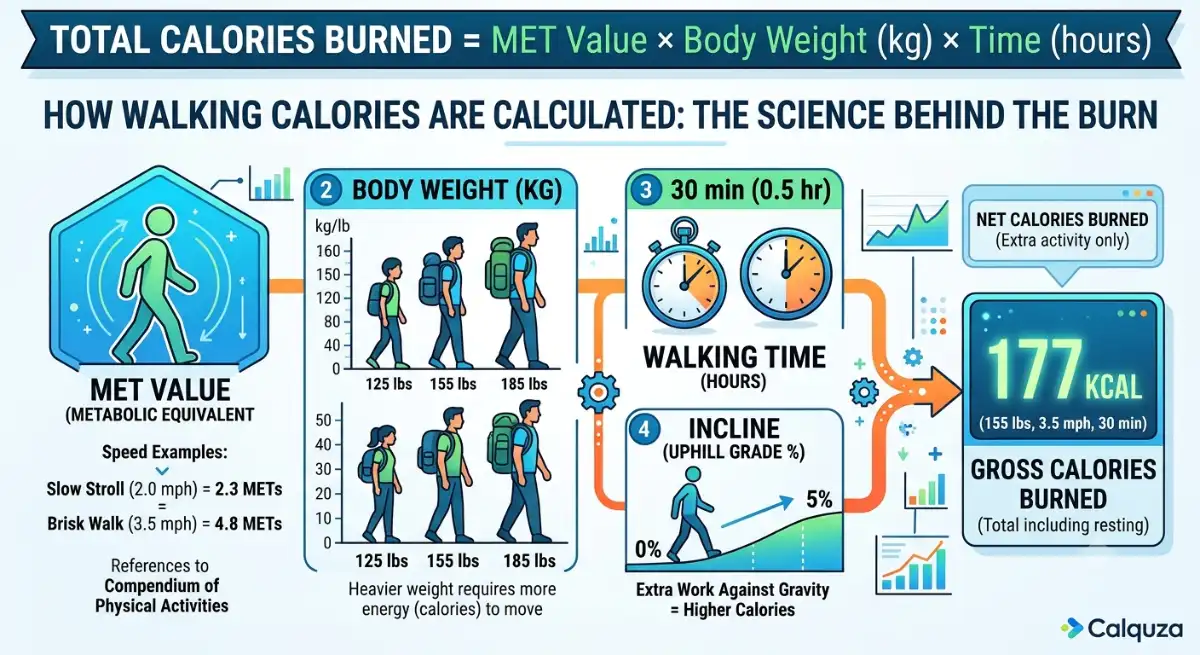
How walking calories are calculated using MET values
How walking calories are calculated using MET values, walking speed, body weight, and exercise duration.

The formula is the standard one used in exercise science:

Calories burned = MET × weight in kg × hours walked

MET stands for metabolic equivalent. It is a number that says how hard an activity is compared with sitting still. MET values come from the Compendium of Physical Activities (Ainsworth et al., 2011): 2.8 at 2.0 mph, 3.0 at 2.5 mph, 3.5 at 3.0 mph, 4.3 at 3.5 mph, 5.0 at 4.0 mph and 7.0 at 4.5 mph.

For hills, the American College of Sports Medicine walking equation adds the extra oxygen cost. In plain terms, every percent of grade makes the same pace noticeably harder.

There are two ways to look at the result. Total includes the calories your body would have burned anyway while resting. Net subtracts that, leaving only what the walk itself added. Net is the number to use if you are working out how much extra food a walk "earns".

To turn steps into distance, about 2,100 steps per mile is a common average for adults. Taller people take fewer, shorter people take more.

What changes your calorie burn

Body weight. Moving more mass costs more energy. That is why the same walk burns more for a heavier person.

Speed. Going from 3 to 4 mph raises your hourly burn by roughly 40 percent.

Hills and stairs. A 5 percent incline at 3.5 mph pushes the burn up by about 55 percent. If your route is flat, even a short hilly loop makes a difference.

Surface and wind. Sand, snow, grass and headwinds all make walking harder than a smooth sidewalk or treadmill.

Carrying weight. A loaded backpack adds to your effective body weight.

Fitness and stride. Fitter walkers are more efficient, so they usually burn a little less than the formula predicts. Arm swing and a longer stride push it a little higher.

Ways to burn more on your usual walk
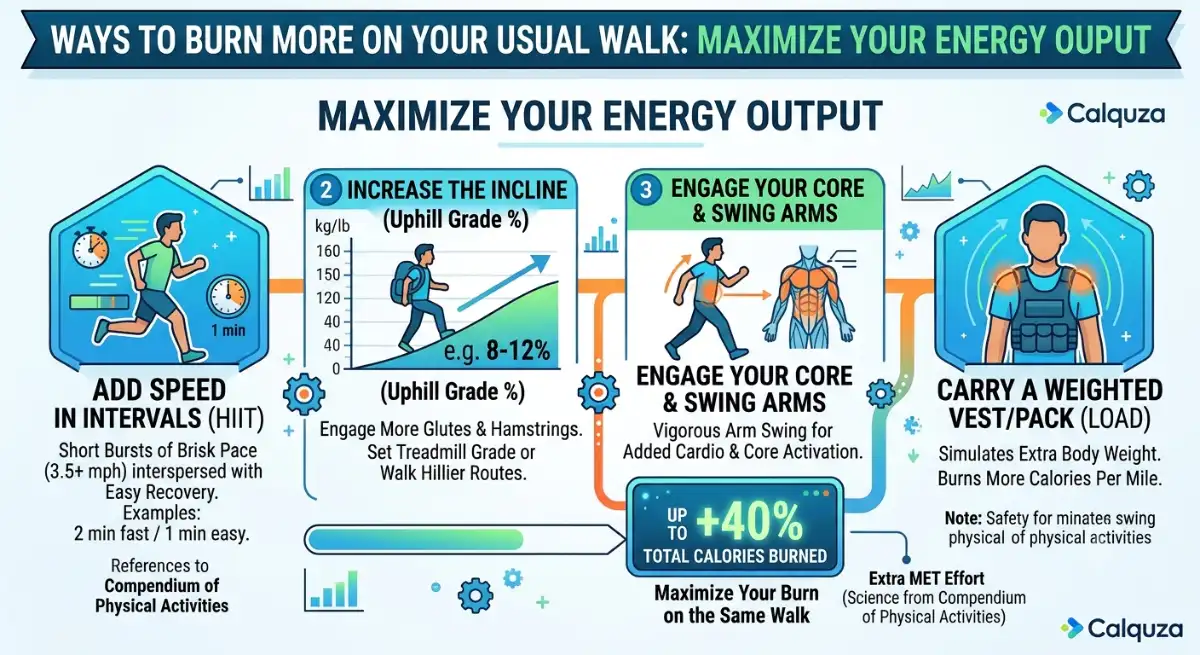
Incline walking workout to burn calories while walking uphill
Incline walking workout showing how uphill walking can increase exercise intensity and calorie burn.

You do not need to walk longer to get more out of it. Try short bursts of faster walking, say two minutes brisk then two easy. Pick a route with a hill or two. Swing your arms. Walk after meals; it is easy to fit in and a 10 to 15 minute stroll after dinner adds up over a week.

The CDC recommends at least 150 minutes of moderate activity a week for adults. Brisk walking counts. That is 30 minutes, five days a week.

These figures are estimates for general information and are not medical advice. If you have a health condition or are starting a new exercise routine, check with your doctor first.

Frequently
Asked Questions

A walking calorie calculator is an online tool that estimates how many calories you burn when walking. You simply enter your personal details – like your weight and walking pace – and the tool does the math for you. In other words, it’s a user-friendly way to see how many calories your walk has burned. For example, one calculator “will take you through your walking habits and, based on them, estimate the number of calories burned, as well as the weight lost this translates to”. Another explains it “predicts the calories burned by walking various distances at a variety of speeds for walkers of different weights,” and can even estimate weight loss. So basically, it’s a convenient calculator that uses standard exercise formulas to give you an estimate of your walking workout.

Using a walking calorie calculator is usually quick and easy. First, enter your body weight (in pounds or kilograms). Next, input your walk details: typically this means the distance of your walk, the time it took, or your average speed. Some calculators ask for two of those three (distance, time, or speed), and then automatically solve for the third. For example, one set of instructions says: enter your current weight and the walking surface slope, then enter any two of distance, time, or speed. The calculator “will automatically calculate the third on its own”. Don’t forget to select a flat or uphill/downhill slope if asked – uphill burns more calories, downhill fewer. Finally, hit calculate and you’ll see the result: calories burned (and sometimes the equivalent weight loss). The process just takes a few inputs, and then the walking calorie calculator provides your estimate.

Several factors influence how many calories you burn during a walk. The main ones are your weight, walking speed (pace), duration (time), and the incline of the ground. In general, a heavier person burns more calories doing the same walk than a lighter person. Walking faster or for a longer time also burns more energy. Incline is key: walking uphill burns significantly more calories than walking on flat ground or downhill. As one source explains, the number of calories depends on “your speed, the duration of exercising, your weight, and the slope”. In fact, going down a hill burns fewer calories than going up, because gravity assists you. Other factors can add up too: carrying a backpack or being older can change your burn, as can a person’s sex or step length. But broadly, weight, pace, time, and slope are the biggest determinants of calories burned while walking.

It really depends on the person and the walk, but here are some typical examples. A 155-pound person walking briskly for 30 minutes on flat ground burns roughly 150–160 calories. If that same person walks for an hour (about 3.5 mph), they might burn around 267 calories. Another way to look at it is by steps: about 10,000 steps in a day burns roughly 500 calories for an average 165-pound man. A lighter person would burn a bit less, and a heavier person a bit more. These numbers are just estimates, but they show the order of magnitude. Using a walking calorie calculator with your exact weight, distance, and time will give you a personalized estimate. For example, if you enter your data into one tool, it’ll compute exactly how many calories were burned in that specific walk.

Yes – walking can definitely help with weight loss when it’s part of a calorie-controlled plan. Every calorie you burn by walking adds up toward a calorie deficit (burning more than you eat). For instance, one source notes that walking for 30 minutes burns about 150 calories. Doing that five times a week adds roughly 750 calories of energy expenditure. That supports weight loss, as long as you keep your diet in check. Moreover, experts say walking is “an excellent way to lose weight” because it’s low-impact and requires no special skills. In practice, a walking calorie calculator helps here by showing how many calories your walks add up to. Then you can use that information to adjust your food intake or exercise plan. In short, walking burns real calories, and tracking it can motivate you – but remember that diet and consistency also matter for losing weight.

Keep in mind that walking calorie calculators give you rough estimates, not exact measurements. They work by applying average values and scientific formulas (like MET values or ACSM equations) to your data. For example, one calculator converts METs to calories using the formula Calories = MET × 3.5 × weight(kg) / 200 × minutes. That math is solid, but every person is different. Muscle efficiency, metabolism, walking style, and other factors can make real calorie burn higher or lower than the estimate. As Kalo Health puts it, the results “are educational estimates and can differ from measured energy expenditure”. In other words, treat the calculator as a helpful guide. It’s great for comparing workouts or planning, but don’t expect it to be 100% precise. Use it to set goals and trends, knowing there’s always some natural variation in actual calorie burn.

Anit Maurya - Digital Tech Expert
✓
AUTHOR

Anit Maurya

Digital Tech Expert • App & Web Developer • Content Writer

✦ 7+ Years of Experience Technology & Digital Solutions

I'm Anit Maurya, a digital tech expert with over 7 years of experience in app and web development and content writing. I build useful web applications, create practical digital products, and publish clear, SEO-optimized content. My goal is to turn complex subjects into simple, easy-to-understand information while developing reliable web tools that provide real value to readers.