
Caffeine Half Life Calculator
See how much caffeine is in your body hour by hour, and when it will be low enough for a good night’s sleep. Free, instant, and nothing is stored.
1. Add your drinks
2. Your settings
Half-life used: 5.0 h
Quick calculation
Remaining = Dose × 0.5(hours ÷ half-life)
Result
Caffeine remaining
–
Time to drop below target
–
Today Your caffeine timeline
Bedtime level by metabolism type
Estimates only. Real half-lives vary widely. Not medical advice.
How Does the Caffeine Half Life Calculator Work?
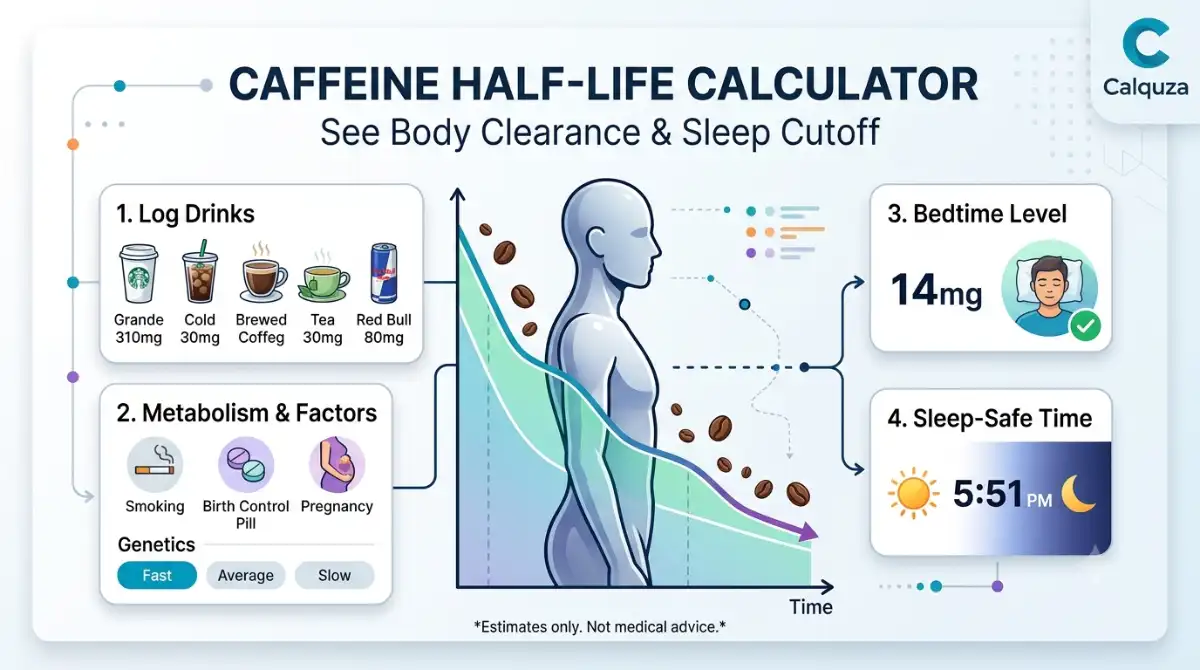
The caffeine half life calculator takes a few simple details and turns them into a clear timeline. First, you pick a drink from the list. Each option comes with a typical caffeine amount in milligrams, such as 95 mg for an 8 oz cup of brewed coffee. You can also type your own number if your drink is not listed.
Next, you enter the time you drank it. You can add as many drinks as you like. Many people log their morning coffee, an afternoon soda, and a late energy drink to see the full picture.
Then you adjust your settings. You choose your bedtime and a sleep-safe level. You also pick a metabolism type, from fast to very slow. If you smoke, take oral contraceptives, or are pregnant, you can tick a box to fine-tune the result.
After that, the calculator builds a chart of your caffeine level across the day. It shows your level right now and at bedtime. It also shows your peak and the time you will reach your sleep-safe level. Because the tool updates instantly, you can test “what if” scenarios. For example, you can move your coffee an hour earlier and watch your bedtime number drop.
The Single dose tab works even faster. You enter a dose and the hours since you drank it. The tool then tells you how much caffeine remains.
How to Calculate Caffeine Half-Life
Caffeine half-life describes the time your body needs to clear half of the caffeine you consumed. Your liver does most of this work. It breaks caffeine down using an enzyme called CYP1A2. Once you understand this simple idea, you can estimate your own levels without any special tools.
The Caffeine Half-Life Formula
The math is friendlier than it sounds. Use this formula:
Here is what each part means:
The exponent tells you how many half-lives have passed. After one half-life you keep 50 percent. After two you keep 25 percent. After three you keep about 12.5 percent. So the amount drops fast at first and then fades slowly.
Keep in mind that our full daily planner adds one extra step. Caffeine does not hit your blood the instant you swallow it. It takes roughly 30 to 60 minutes to absorb. Therefore the planner models a short rise before the decline begins. The quick formula above works well for a simple estimate.
Example: How Much Caffeine Remains After 10 Hours?
Let’s walk through a real example. Say you drink a 200 mg cold brew at 8 AM. You have an average half-life of 5 hours. You want to know your level at 6 PM.
- Ten hours have passed since your drink.
- Divide 10 by 5 to get 2 half-lives.
- Multiply 0.5 by itself twice to get 0.25.
- Multiply 200 mg by 0.25.
You end up with 50 mg still in your system.
In other words your body cleared 150 mg but a quarter of your drink still lingers. That amount is about the same as a strong cup of tea. Now imagine your half-life is 7 hours instead. The same drink would leave about 74 mg at 6 PM. This gap explains why two friends can share a coffee and sleep very differently.
How Long Does Caffeine Stay in Your System?
Most healthy adults clear half their caffeine within 3 to 7 hours. The average sits near 5 hours. However full clearance takes much longer than people expect. After about 10 hours a typical person still holds roughly a quarter of the original dose. After 15 hours around 12 percent remains.
Here is a quick look at a 200 mg dose with a 5-hour half-life:
Notice that the caffeine does not vanish after “a few hours.” Instead it fades gradually. As a result a coffee at noon can still leave a meaningful amount in your body at 10 PM.
Detection also differs from effect. Lab tests can spot trace caffeine in blood or saliva for a day or more. Yet most people stop feeling the buzz much sooner. Even so low levels can still nudge your sleep quality without making you feel wired.
How Much Caffeine Is Left in Your Body at Bedtime?
This question matters most for sleep. Caffeine blocks adenosine, a chemical that builds up during the day and makes you sleepy. When caffeine sits in your system at night it can make falling asleep harder. It can also reduce deep sleep. You may not notice the change but you often wake up feeling less rested. In fact a sleep study published in the Journal of Clinical Sleep Medicine found that caffeine taken even 6 hours before bed cut total sleep time.
Our caffeine half life calculator answers this question directly. It marks your bedtime on the chart and shows the exact milligrams left. You also get a color-coded verdict:
You are under your sleep-safe level.
A moderate amount that sensitive sleepers may feel.
A high level that can cost you sleep.
Most people choose a sleep-safe level between 10 and 50 mg. A strict 10 mg target suits light sleepers. A 25 mg target works well for most adults. Meanwhile 50 mg suits people who handle caffeine easily.
The tool also gives you helpful tips. It names the drink that contributes most to your bedtime level. It also shows the latest time you can enjoy one more 8 oz coffee without crossing your limit. So you can plan your day with confidence rather than guesswork.
Here is a simple habit that helps. Set your last caffeinated drink at least 8 to 10 hours before bed. Then check your result with the calculator and adjust from there.
What Affects Caffeine Half-Life?
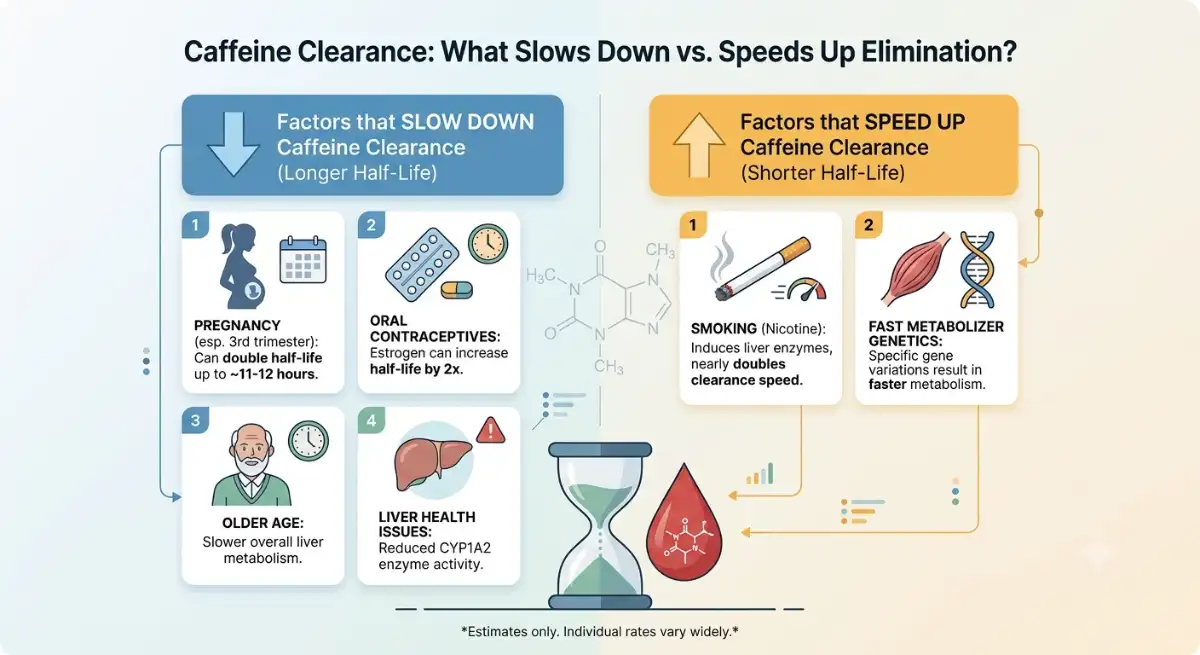
Factors that slow down versus speed up caffeine metabolism in the human body.
Your half-life is not fixed. Several factors speed it up or slow it down. Understanding them helps you choose the right settings.
You can reflect most of these factors in the calculator. Choose a metabolism type and tick the boxes that apply to you. The tool then shows the half-life it used so you can see exactly how it reached your result.
Caffeine Content in Coffee, Tea, and Energy Drinks
Knowing your dose is half the battle. Caffeine content varies by brand and brew style. The numbers below are typical averages for popular US drinks:
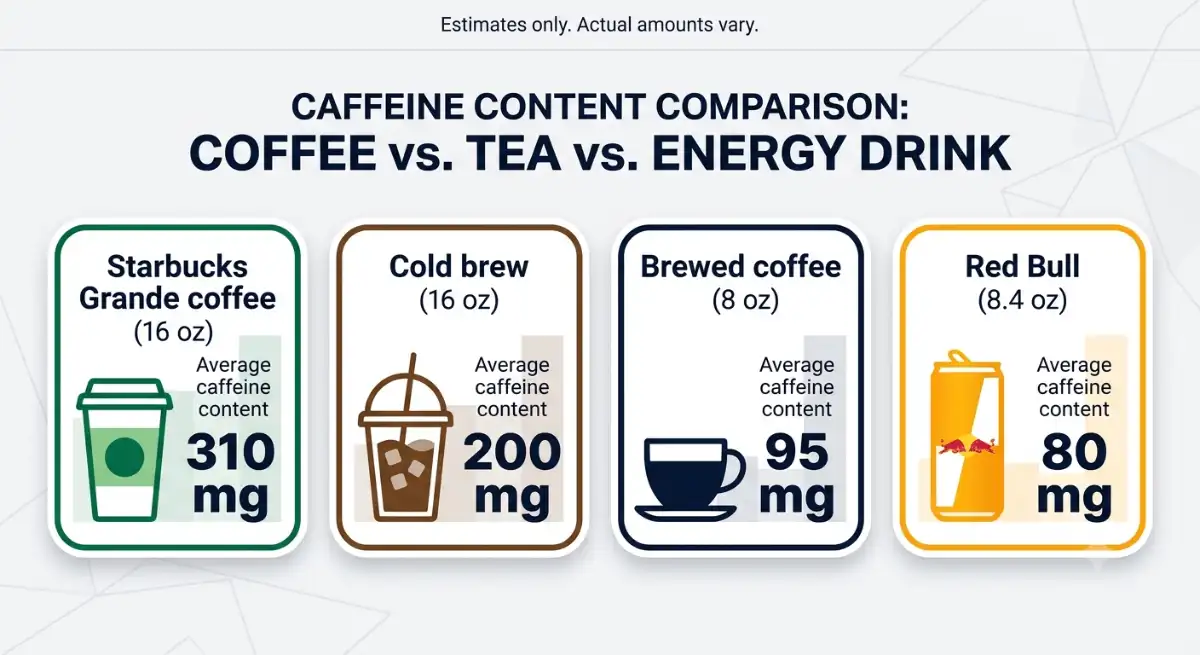
Average caffeine content (mg) comparison for popular drinks. Visual estimates only.
| Drink | Caffeine (mg) |
|---|---|
| Brewed coffee (8 oz) | 95 |
| Starbucks Grande coffee (16 oz) | 310 |
| Espresso shot | 63 |
| Cold brew (16 oz) | 200 |
| Black tea (8 oz) | 47 |
| Green tea (8 oz) | 28 |
| Cola (12 oz) | 34 |
| Red Bull (8.4 oz) | 80 |
| Monster Energy (16 oz) | 160 |
| Pre-workout (1 scoop) | 200 |
| Caffeine pill (200 mg) | 200 |
| Dark chocolate (1 oz) | 23 |
| Decaf coffee (8 oz) | 2 |
Two points stand out. First, a large coffee shop drink can hold more than three times the caffeine of a home cup. Second, even decaf contains a small amount. Small amounts can add up if you drink several cups.
The FDA says up to 400 mg of caffeine per day is generally safe for healthy adults. That equals about four 8 oz cups of brewed coffee. Still your own limit may sit lower. If you feel jittery or notice a racing heart you may want to cut back. The Mayo Clinic guide to caffeine lists more warning signs worth knowing.
Remember that labels and recipes differ. If a brand lists its caffeine content use that number. You can type it into the custom drink option for the best accuracy.
Final Thoughts
Caffeine is not the enemy. Timing makes all the difference. With this caffeine half life calculator you can see your levels clearly and plan your day around them. Therefore you can keep your favorite coffee and still protect your sleep. Try it today and test a few schedules until you find your sweet spot.
Please note that results are estimates and not medical advice. If you have health concerns talk with your doctor.
Frequently Asked Questions
What is caffeine half-life?
Caffeine half-life is the time your body needs to clear half of the caffeine you took in. Most healthy adults land between 3 and 7 hours, and 5 hours is a common average. If you drink 200 mg of caffeine and your half-life is 5 hours, about 100 mg remains after 5 hours and about 50 mg remains after 10 hours.
How long does caffeine stay in your system?
Caffeine keeps working in your body much longer than the buzz suggests. With a 5-hour half-life, about a quarter of your dose is still there after 10 hours and about 12 percent remains after 15 hours. Lab tests can find trace amounts in blood or saliva for a day or more, even though most people stop feeling the stimulant effect sooner.
How many hours before bed should I stop drinking caffeine?
A safe starting point is 8 to 10 hours before bedtime, and the American Academy of Sleep Medicine advises at least 6 hours as a bare minimum. Sensitive sleepers and slow metabolizers need the longer gap. Nothing speeds up clearance, so the only fix is timing. Enter your drinks and bedtime in the calculator to see your own cutoff.
How much caffeine is left at bedtime if I drink coffee at 2 PM?
It depends on the dose and your metabolism. Take a 200 mg drink at 2 PM and a 10 PM bedtime. That gives 8 hours, or 1.6 half-lives at a 5-hour half-life, so about 66 mg remains. A slow metabolizer with a 7-hour half-life would still carry about 91 mg. That is above most sleep-safe targets of 10 to 50 mg.
Why does caffeine affect people so differently?
Your genes decide how fast your liver makes the CYP1A2 enzyme that breaks caffeine down. Beyond genetics, smoking shortens the half-life while oral contraceptives and pregnancy lengthen it. Liver health, certain medications and age also play a part. That is why two people can drink the same coffee and sleep very differently.
How accurate is the caffeine half life calculator?
The calculator gives a solid estimate rather than an exact lab reading. It uses the standard half-life formula, adds a short absorption phase and adjusts for the factors you select. Real half-lives vary from person to person, and caffeine amounts differ by brand and brew. For best results, use the label value for your drink and pick the metabolism type that matches how you feel. The results are not medical advice.